

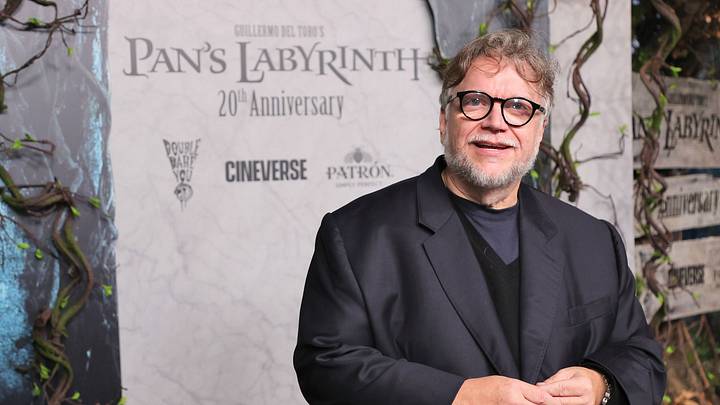
20 years after its initial release, writer-director-producer Guillermo del Toro's highly-acclaimed 2007 film, Pan’s Labyrinth has returned to theaters with a brand new 4K remaster in 3D. The resulting viewing experience invites audiences both to get lost within the story of del Toro’s film and also to consider the ways in which things have changed — or failed to change — in the intervening years, both within the film industry and on a more sociopolitical scale at large. If you love Pan’s Labyrinth, I can’t recommend seeing it in this way enough; the resulting presentation is immersive and utterly encompassing on a whole new level. And if you haven’t seen Pan’s Labyrinth, I can think of no better way to lose yourself in it than with this new 20th anniversary re-release.
Guillermo del Toro made his cinematic debut in 1992, with the independent film, Cronos. That film is stellar to this day and serves as an invaluable Rosetta Stone of sorts through which to view each subsequent film that the master craftsman has made: it’s a story full of broad genre strokes that contains deceptively nuanced pathos-laden emotionality, set in a cinematic landscape that feels meticulously sculpted at every turn. Yet, the film was made on a sparse budget, largely assembled by del Toro himself. Thus the question was inevitably posed: what happens when a cinematic talent of this magnitude acquires the means to fully realize his own ambitions onscreen?
While del Toro would go on to make many great films between ’92 and ‘06, they often felt like splitting the difference between the commercial and the artistic. Something like Blade II may feature lots of del Toro’s trademark design work, but it isn’t the kind of wholly original work that the director was so eager to make. Conversely, something like Devil’s Backbone (a phenomenal film) allows him to express himself in a much more cohesive and all-encompassing way, but on a far smaller canvas. In many ways, Pan’s Labyrinth represents the marriage of these two sides of del Toro’s creative psyche, marking the first real time he had the carte blanche to capture one of his fantastical visions in celluloid and hold nothing back.
In the decades since Pan’s Labyrinth, del Toro has gone on to do this time and again, and yet Pan’s still stands as a benchmark moment in the trajectory of his filmography for a reason. It was a hugely ambitious production in every possible way, and yet somehow, its legacy as a film has gone on to succeed even those lofty ambitions.
The most revelatory aspect of watching Pan’s Labyrinth on the big-screen in 2026 is seeing just how astonishingly well it has aged. In the crafting of the screenplay, Guillermo del Toro was actively channeling classical fairytale influences into a story overtly about the innocence of childhood being snuffed out by the brutality and ignorance of adulthood, and how storytelling serves a viable respite from the hardships of reality. The story may be set in 1944, yet its tale somehow feels even more vitally prescient today than it did upon release in 2006.
So for as stunning as the 4K and 3D are on a technical level and certainly a fascinating aid, it would be untrue to say that they are what pulled me so viscerally back into the world of Pan’s Labyrinth; it was simply the transcendent story and the phenomenal cinematic craftsmanship, the same as it has always been. In this way, watching the film this time around with a full theater solidified a belief I’ve held for years: this film will age into a time-tested classic of the genre right alongside works like Disney’s Alice in Wonderland or The Wizard of Oz; timeless fables that only cultivate larger followings the further away from their release they get.
One thing I adore about the work of Guillermo del Toro is his ability to reinterpret classical influences or monumental texts through such an idiosyncratic lens. I am a huge fan of Jack Arnold’s 1954 film Creature from the Black Lagoon (shout-out to Sun-Ray Cinema for projecting it on 35mm film, also in 3D last week), and the ways in which del Toro’s Academy Award-winning 2017 film, The Shape of Water, is able to recontextualize the characters and themes at play within the original film in way that feels both deconstructive and celebratory, is entrancing. The same is true of other works, such as Nightmare Alley, Pinocchio, or most recently Frankenstein, but Pan’s Labyrinth may very well stand as my favorite of all of these, for the way in which it engages not only with fairy tales themselves but the history of them through the ages.
Verdict
Pan’s Labyrinth has stood the test of time not only as one of the defining works of Guillermo del Toro’s career, but of the 21st century, period. It’s an all-timer in every sense of the word, and seeing this remastered version on the big screen is an experience I cannot recommend enough.
GRADE: A
 Add us as a preferred source on Google