

The Lord of the Rings: The Rings of Power never fails to acknowledge J.R.R. Tolkien's love of languages. In many ways, he was a linguist before anything else. Galadriel (Morfydd Clark) uses Nenya for magic here, finally starting to seem the Lady of Lórien of The Lord of the Rings. Chanting Sindarin to summon butterflies and throw the Nazgnagôl off her trail, she whispers perhaps “an-nath aem,” which may roughly equate to asking for help. Or perhaps it’s something with “amarth,” the Sindarin word for doom or fate. Either way, the White Lady lives.
Meanwhile, the show’s “Gaudrim” appears to build on Sindarin roots: gaud, meaning “device” or “contrivance,” and -rim, meaning “people.” That makes them machine-people, and machines were always associated in Tolkien with evil. Gandalf’s mûmak, meanwhile, carries the Southrons’ own word for oliphaunts. These are the finishing touches on an episode that takes big chunks of lore and makes moves that could drive debate for years.
Assassin’s Creed: Rhûn edition
Tom Bombadil (Rory Kinnear) and Gandalf (Daniel Weyman) sneaking around Rhûn together is more Assassin’s Creed than Lord of the Rings, but one gets the impression that Payne and McKay know it. It’s absurd, it’s hilarious, and none of it is canon. Whether Tolkien is spinning in his grave or not at these scenes is frankly very hard to discern. Comedy takes risks. Perhaps future adaptations, and the legacy of creativity this leaves them, will be the best judge of that.
We like to think that Tolkien would love the mûmakil bit, though—Gandalf bringing the mûmak to heel and freeing it from its armor. Tolkien had a soft spot for oliphaunts. He wrote them through Sam’s eyes in The Two Towers as oppressed but magnificent creatures, and he wrote poetry about them. When the mûmak in Ithilien crashes away into the wild, Sam wonders whether it escaped to roam free for a while, far from war. The show gives that wish a happy ending. It’s nicely Jacksonian too.

Tom’s last song
Bear McCreary did something generational in creating Tom Bombadil’s theme. Tom’s song is utterly key to the legendarium. Tom started life in a 1934 poem, which grew into Tolkien’s 1962 collection The Adventures of Tom Bombadil, as well as his chapters in The Fellowship of the Ring. McCreary’s theme feels as close to what Tolkien may have imagined as possible. It’s a bit 60s Disney, à la “Feed the Birds” from Mary Poppins, a bit Howard Shore, and completely heartbreaking in its own gentle way. Paradoxically, that is what a theme tune for the living embodiment of life itself must be. It’s chilling, it’s sublime, and as Tom dances around his house to it, one can’t help but feel that perhaps we are seeing the last of him.
Tom tells Gandalf: “Sing, and Tom will be with you.” That’s basically what Tom told Frodo and the hobbits in Fellowship, when he taught them a rhyme to call him in danger. So while his Rhûn storyline never happened in the books, the script often draws from deep wells of lore.

Gandalf’s hat gets its due
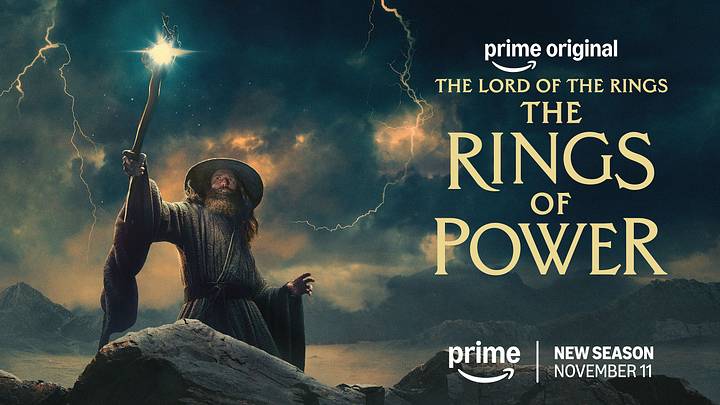
Another epic moment Tolkien definitely never wrote is Tom Bombadil disappearing, as he does, leaving nothing but his hat, and Gandalf putting it on. Weyman told Far Out Magazine there was “quite an energy on set” when the hat went on, and it shows.
But The Rings of Power is a prequel, and these are the moments that make prequels. They exploit our nostalgia by showing us how myths were made. And this nostalgia isn’t just for books, it’s for what may be the world’s best trilogy of movies. It’s for whole childhoods. If the show didn’t exploit that nostalgia, it would have failed. It also says something important. This is not just Sauron’s origin story; it’s Gandalf’s origin story too, even if Gandalf’s origin story is not from the books, while Sauron’s is. As Terry Pratchett, the famous Tolkien acolyte, wisely said: “A wizard without a hat was just a sad man with a suspicious taste in clothes.” It seems things are starting to look up for Gandalf.
A god gets a speaking part
Gandalf speaking to the Secret Fire may be one of the show’s biggest swings so far, and this original material is a huge deal. Eru Ilúvatar, the god of the legendarium, sent the Secret Fire into the world to give it life. Tolkien was a Catholic, and many scholars see the Secret Fire as the Holy Spirit, one part of the Holy Trinity. When Gandalf faces the Balrog in Moria, he calls himself a “servant of the Secret Fire,” a title this episode now earns.
The swing is not the Secret Fire speaking to Gandalf. Ilúvatar himself sent Gandalf back after his death to return as Gandalf the White, so clearly he has a very special place in Ilúvatar’s plan. The swing is putting Eru Ilúvatar on screen at all. Can such a thing be televised? Should it be? Well, it’s not as if cinema has never tried to put God on screen before, so the only real question is whether it works.
“Only together can you prevent the armies of Rhûn from joining Sauron” is such an explicit thing for a god to say to an Istar. Eru probably didn’t mince his words, but would he speak in such human terms? Eru speaks in winds blowing the right way at the right time, in chance meetings, in chance itself, which is of course not chance but his will. It seems a little mundane for Eru to just, well, speak.
Nonetheless, the ambition of bringing the cosmology of the Ainulindalë, the iconic first part of The Silmarillion, to television is to be respected. The Rings of Power hasn’t backed away from the core of this story: a god made all things, and an angel fell from grace desiring to usurp him, inspiring countless others to try to usurp their natural mortality or state of being. In this scene, the show has made that unignorable.
It’s hard to say whether such an on-the-nose depiction of the show’s innately Catholic creation myth does more good than harm overall. The show has to reach people who have never read the books and may never do so. Possibly the best takeaway is that it is possible to televise the First Age and The Silmarillion. Maybe, just maybe, someone should devote time to that in a way that can do the Secret Fire more justice.

The Dark Wizard has a name
Finally, the Dark Wizard is revealed as Pallando. This rights victory feels momentous for the Tolkien fandom, considering the show started with the rights only to The Lord of the Rings and its appendices. Unfinished Tales shares a rumination of Tolkien’s in which, of the five Istari, Alatar was chosen by the Vala Oromë, and Alatar chose his friend Pallando to come with him on his mission to Middle-earth, sealing his fate as one of the five. These two were the Blue Wizards.
In this episode, it’s revealed that Pallando killed his partner, an act so evil it turned Rhûn to waste. This is an invention on the show’s part, but it doesn’t clearly contradict anything Tolkien wrote. In one letter, Tolkien suspected that the Blue Wizards failed and founded secret cults in the East that outlasted Sauron’s fall. So it’s a fair punt on the show’s part to show the Dark Wizard leaning towards evil despite inner conflict.
The Dark Wizard calls Khamûl (Zubin Varla) a Gaudrim, the name the show gave the Dark Wizard’s masked Easterling warriors in season 2. Khamûl needs some screen time to portray some of the magnetism attributed to him by Sauron’s “fairest of the Nine” epithet, but his answer here is a mic drop. He is a Gaudrim no longer, but a ring-servant of Sauron. Khamûl’s allegiance to Sauron is canon. The Gaudrim are not.

Anárion: Númenor gets its Andor
In this episode, Anárion (Andrew Richardson) enters the frame. This is why The Rings of Power exists. Perhaps there are Tolkien enthusiasts out there cringing in the bleachers at such an old character, never before seen on screen, finally taking the pitch. After all, he can’t look how every single person imagined him. But this is strong casting, and the characterisation works well too.
Anárion was a crayon stick figure in the legendarium compared to characters like Frodo, barely imagined. In the books, he is Elendil’s younger son, who founds Gondor with Isildur and dies in the siege of Barad-dûr. He was certainly on the side of good. But here he is a rebel, an activist leading an undercover resistance, à la Star Wars. He’s almost an Andor figure, and that works for him. Isildur (Maxim Baldry) is giving this too.
They are inspirational leaders, but they seem to be circling that great, age-old void of “the end justifies the means.” It’s the void of going too far, betraying their own strong principles and stooping to their enemies’ lows in their desperation to beat them, which they know must happen for good to prevail in the long term. Tolkien’s whole saga turns on refusing that temptation. The Ring is the ultimate means to an end, and the wise refuse to use it. As we all know, Isildur falls into that void in the end, so the show is right to push him towards it.

Marnûkh writes poetry, Sauron hates his name
Marnûkh (Adam Young) shares his poetry with his little fellowship and gets embarrassed about it, highlighting the parallel between his fellowship and that of Frodo and Sam. Except in The Lord of the Rings, it’s Sam who gets embarrassed about his poetry.
His line about a fellow lost whom no one grieves, and whom none can ever bring back, is hard-hitting, to Marnûkh’s credit. It feels big. It feels like closure. Tolkien wrestled throughout his entire writing career with good, evil and free will, and with whether the Orcs, as living, thinking beings, could be pure evil. At some point, he appeared to realise that they couldn’t. Although this blossoming of thought didn’t quite result in any great redemption of the Orcs, close readers of The History of Middle-earth may get the impression that Tolkien had regrets.
“As Sauron, I am at your mercy.” Charlie Vickers’ nuanced acting speaks volumes here. When he says the word “Sauron,” he mocks it. That’s because it means “the Abhorred” and is actually an insult created by the Elves. His original name was Mairon, “the Admirable.” It’s a detail from the legendarium that Vickers is clearly aware of.
The Rings of Power season 3 continues on Prime Video on November 18. Catch up on the new characters coming in season 3 and the season’s release schedule. Check back with us at Winter Is Coming for the latest news on all things Middle-earth.
 Add us as a preferred source on Google