

This episode has some serious bait-and-switches, and more to unpack than the Hobbits at Crickhollow before they started their quest. It’s welcome after the mystery-box writing that characterized seasons 1 and 2, which teased Sauron’s identity in season 1, then Gandalf’s in season 2. That build-up certainly had its merits, but this season is getting down to business, putting wheels in motion for season 5’s War of the Last Alliance.
Abandon hope of a spoiler-free read on episode 6, ye who enter here.
It’s semi-tempting to say this season is starting to need more funny moments, like the introduction to Dwarf life in episode 1. But does it? Why does it have to be Peter Jackson? The Silmarillion was hardly a barrel of laughs. Sauron’s uncanonical torture of Celeborn (Jamie Campbell Bower) in this episode is no barrel of laughs. Nor is Pharazôn’s (Trystan Gravelle) canonical proposal to Míriel (Cynthia Addai-Robinson), his own first cousin, against Númenor’s laws.
Was this the machine Sauron had Gollum in when he pried the words “Shire” and “Baggins” out of him in The Lord of the Rings? We’ll never know. Well, unless The Lord of the Rings: The Hunt for Gollum tells us when it comes out in 2027.

Not weakness, but pity
Pity is so important in The Lord of the Rings, as it is here. Pity stayed Bilbo’s hand when he could have killed Gollum, and Frodo gives Gollum second chances. Galadriel (Morfydd Clark) always gives second chances too. She does so here for the original character Theo (Tyroe Muhafidin), who tracks her down to tell her that Sauron (Charlie Vickers) has Celeborn and is trying to torment the secrets of ring-making out of him. Theo killed Arondir (Ismael Cruz Córdova), another original character, in front of her, but she helps Theo anyway, and they set off to find Celeborn.
Elendil (Lloyd Owen) also gives second chances, to the original character Kemen (Leon Wadham). Elendil tells his son, Anárion (Andrew Richardson), that he gave Kemen his own food: “It was my ration.” This triumph of a line demonstrates Aragorn’s stock: a line of heroes who championed human rights before there were even words for them.
It’s quite possible that the pity dished out in this episode empowers the Ringwraiths rather than bringing about Sauron’s downfall, as it does in The Lord of the Rings. Showrunners J.D. Payne and Patrick McKay are good, but they may not be quite good enough for every occurrence to ripple perfectly into the final outcome as it does in J.R.R. Tolkien. Well, we can’t all be Tolkien. But the characterization is good, and the series hasn’t laid all its cards on the table yet.

Location, location, location
Galadriel and Theo travel to Mordor via Lórien. It isn’t yet the realm it becomes in the Third Age. In Tolkien’s notes, Lórien was first inhabited by Nandorin princes, and Galadriel and Celeborn only settled there after the downfall of Eregion. So the show’s timing is quietly right. The trees on a hill, Caras Galadhon, are just as Tolkien intended, and partially inspired by world-renowned Tolkien illustrators John Howe and Alan Lee.
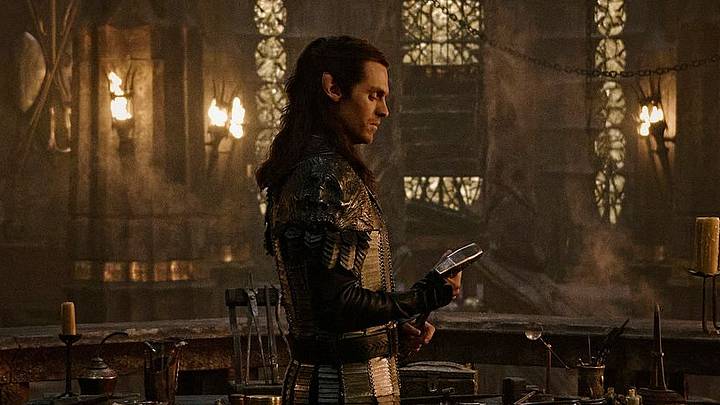
Speaking of location, location, location, the look inside Barad-dûr in this episode has no textual basis, but only because the text never looks inside Barad-dûr. Its gold accents, anguished decorative masks, and black rock feel as Mordorian as anything Howe or Lee could have imagined.
Elsewhere in Númenor, Elrond (Robert Aramayo) is trying to keep the peace between the Faithful and Pharazôn, between whom war is brewing. Gil-galad (Benjamin Walker) and Míriel meet, and he heals her blindness. These scenes are not The Silmarillion, but the characters are, and their believable interactions are such a revelation after reading it and imagining for so many years what could have been. Long live the high-budget Unsilmarillion, haters be damned.

Celeborn vs Sauron
Sauron has Celeborn chained in a cell, and Celeborn asks him why he’s doing all this, with a gentleness that suits him. Sauron says it will bring him bliss. Existence, he says, has but one true joy above all others: to know, to feel the precise moment another being submits his or her will to yours. There is no greater pleasure, and he shall have it with all, for always. Celeborn asks: “So you’re doing all of this because it makes you feel good?” And the answer is: “Isn’t that the only reason any free being has ever done anything?”
As in every season, Sauron’s argument is seductively watertight, despite Celeborn’s objections. This self-awareness is also everything Sauron lacked in season 2. Sauron tells Celeborn that Galadriel could have been looking for him all the years he was imprisoned, but instead she looked for Sauron. This logic is also watertight. It acknowledges a criticism many have had of the show, then turns it into a malevolent punchline worthy of Sauron’s cruelty in the books.
If Galadriel wanted Sauron so much, where is she? “Perhaps I never wanted her,” is Sauron’s response, cracks showing in his armour. And Celeborn calls him on it brilliantly: “And you call yourself a liar.” In the world of The Rings of Power, perhaps this conversation is what Celeborn thinks about when he storms Dol Guldur in the Third Age, a moment the show won’t get to cover.

The Lord of the Rings is finally the Dark Lord
Mid-torture, Sauron licks Celeborn’s blood off his gauntlet and opaquely says they are now one and can begin. Form fair, don’t care. Sauron in his final fair form, which he will lose at the downfall of Númenor, is just not playing nice anymore. He’s just as creepy as Morgoth was in The Lay of Leithian, and why not? Sauron’s singing from his hymn sheet. The Lord is finally Dark.
According to season 2, Sauron gave Adar blood-red wine to turn him into a Moriondor in the First Age. Perhaps blood magic was afoot in creating Orcs, in this filling of the gaps in the legendarium’s sprawling Orc creation myth. So, Eru knows what devilry Sauron has in store for Celeborn.
Later, Galadriel breaks into Celeborn’s cell. Like hell would Sauron have let that happen. Poor writing, surely. But unfortunately for Celeborn, no. This Galadriel is an illusion. It’s actually Sauron, revealed halfway through a kiss, given by Galadrion as a reward to Celeborn for revealing the secret of ring-making. Poor Celeborn, making innocent conversation, thought she was just being affectionate.

The secrets of the One Ring revealed
The show posits inventively that gold and silver from Valinor make a Ring, as Celeborn lets slip. A heavy-lidded Sauron breathes into Celeborn’s mouth: “And I thought it was bliss when Galadriel submitted to my will.”
The showrunners have said before that they wanted to make The Rings of Power a show for all ages. As fanfic writers puzzle out what this uncanonical scene would look like with a Game of Thrones maturity rating, "Laws and Customs among the Eldar" sits in Morgoth’s Ring as Tolkien’s little-known treatise on Elf procreation. Meanwhile, Prime Video is hitting its stride, confidently doubling down on what works: the drama, the shocks, the new.
The Rings of Power season 3 hasn’t tried too hard to adapt lore, leaving it implicit in the bones of the narrative. Instead, season 3 has done what the show does best. And it’s actually kind of a romantasy. But that would hugely undersell the accomplishment here, because this season does communicate many of Tolkien’s key themes. The Lord of the Rings was a war story, but The Silmarillion wasn’t, and season 3 isn’t. Season 3 is an exploration, via Tolkien’s themes, of the wild highs and lows that must have occurred between those century-sweeping pages for the story to arrive where it does.
The Lord of the Rings was published in 1954, but it’s 2026 now, and in season 3 it’s clear that The Rings of Power fears that fact no longer. And thank God. No one wants to watch an anthology of legendary characters who last an hour max. How could we care about them?

Whose fault are the Rings of Power?
Kissgate does slightly make it look like Celeborn’s fault that Sauron makes the One Ring, given Sauron quickly realises that the fires of Mount Doom would actually be hot enough to melt the unwieldy gold and silver from Valinor. Well, at least Sauron’s Second Age rise isn’t just on Galadriel, as it looked by the end of season 1. This is the opposite of what Tolkien said Galadriel and Celeborn did. They were good guys who never aided or abetted Sauron, even indirectly. But Sauron duped them in the show, as he does. You can’t really blame them, and that’s what makes this interesting.
The Seven Rings are hidden in Khazad-dûm, keeping their many pursuers running in circles. Durin (Owain Arthur) lost his fight with Thráin (Eddie Marsan), who usurped his kingship and has him imprisoned, but Disa (Sophia Nomvete) frees him. “None of this makes me feel good,” says Thráin. The Dwarven storyline is all invention, but pleasure is a welcome theme in this episode, and in the season. Elendil felt good to see Isildur in the previous episode.
The characters here are thinking, feeling, living, breathing beings, which is what they would have been in The Silmarillion if it had been an eight-part novel rather than a historical document. Televising historical documents requires adding detail inevitable in novels—dialogue, emotional reactions, and relationship dynamics. Tolkien only asked, in a letter, that adaptations perceive "the core of the original." Meanwhile, TV must also meet other criteria to be greenlit and continued. The show has many plates to spin, and it's spinning more than it's dropping.
Episodes 7 and 8 of The Rings of Power season 3 premiere on Prime Video on November 25. For more on Celeborn, read what Jamie Campbell Bower has teased about his character’s past, and brush up on the sprawling cast of characters in season 3.
 Add us as a preferred source on Google