

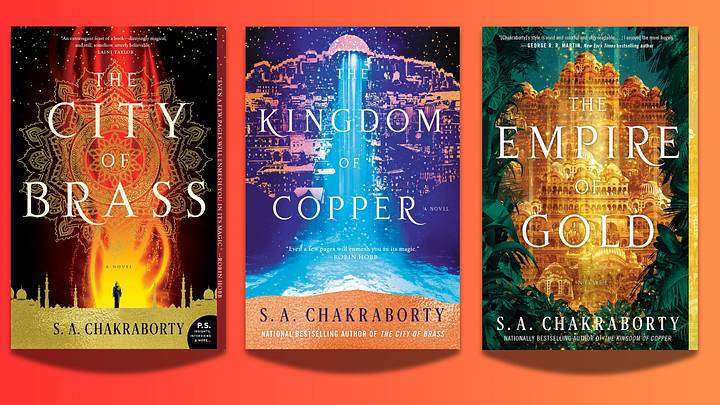
S. A. Chakraborty delivered something satisfyingly unique and immensely entertaining with her Daevabad trilogy. The fantasy series pulls readers away from their medieval setting comfort zone and drops them into the 18th-century Middle East.
So many talented, imaginative contemporary fantasy writers have proved that the genre could be pulled away from its familiar, comfortable roots and still be intriguing in every way. Writers like R. F. Kuang and her Poppy Wars series, Tasha Suri and her Book of Ambha duology, C. L. Clark and the Magic of the Lost series, and N. K. Jemisin in multiple series, take readers into worlds seldom explored in fantasy.
Chakraborty does the same with the Daevabad series, consisting of The City of Brass, The Kingdom of Copper, and The Empire of Gold. None of these works have elves, dwarves, giants, or any other classic fantasy creatures. All do, however, offer different types of magic and unique worlds with which to present their visions.
What makes Chakraborty's Daevabad trilogy so special

The Daevabad series takes place almost exclusively in the world of the djinn in the 1700s. There are very few human characters, and those appear very briefly. There are creatures like the peri, shedu, marid, and others, most of which aren't familiar to the Western world.
Djinn means “hidden from sight.” They are supernatural spirits from ancient pre-Islamic Arabic folklore. Don't get confused by Disney's take on this world in Aladdin. While that story is inspired by the same folklore, it is a long way away from the world Chakraborty creates.
In this series, the djinn are grouped into several tribes, or peoples, each with their own geographical locations but hidden and overlaying human countries. The djinn even have their own city, Daevabad. That city has a long history of violence and is in turmoil because of a king who promotes violence.
There is also an underlying theme of prejudice in the form of “shafit,” who are djinn with human blood. These are people with at least one parent or ancestor that was human. Of course, djinn interacting with humans is strictly forbidden, but there is a surprisingly high number of shafit who live in Daevabad, and they are treated as abominations and second-class citizens.
The story encompassed by the three books is told from the points of view of three main characters. Nahri was raised in the human world and has an unclear past. She finds herself thrust into a violent, political world she is ill-prepared for. She is stubborn, smart, and possesses what could be called street smarts.
Dara is a djinn who has a violent, checkered past and has spent many centuries enslaved to humans. He has no memory of his time of enslavement, but it is clear he has been used as a weapon of violence for most of his life.
Ali is a prince, a second son trained in the military to eventually be his older brother's protector. He is a rigid religious zealot who seldom considers opinions apart from his own. He is inflexible and impulsive.
These three people, with thoroughly different backgrounds and life experiences, are thrown together with alarming results for the world in which they live. The three books cover approximately six years combined. It is one storyline, though each book is a journey for the characters to reach the end.
Each book starts at a somewhat leisurely pace, as Chakraborty builds her world. She does a tremendous job developing in this, knowing that many readers will be unfamiliar with the folklore that inspired these books and characters.
Each book picks up speed and peaks with page-turning action and makes readers want to jump right into the next installment. When the story is finished, she does a tremendous job wrapping up the tale and the characters. She doesn't leave readers hanging with loose ends.
She is patient with her world-building and character development, slowly adding layers to each. Despite each of the three main characters being flawed in many ways, it is easy to grow attached, despite some of the things they do within the context of the story.
It is the world in which this trilogy takes place that is so stunningly different from most fantasy settings. It is far away from the worlds like Middle-earth and Westeros. The magic is different from most classic fantasy worlds, too. Yet, Chakraborty can tell the story in a way that seems familiar to fantasy fans, despite its significant differences.
Chakraborty also leaves the door wide open for a sequel that could involve one of the main characters, or all three of them. It wouldn't be a forced sequel but one that flows naturally from the Daevabad trilogy if she decides to revisit this world.
If you enjoy books that focus on cultures that differ from those of most classic fantasy works, then add the Daevabad series to your list of must-reads. It is a thoroughly enjoyable and entertaining journey that is well worth the readers' time.
Book Review Grade
 Add us as a preferred source on Google