

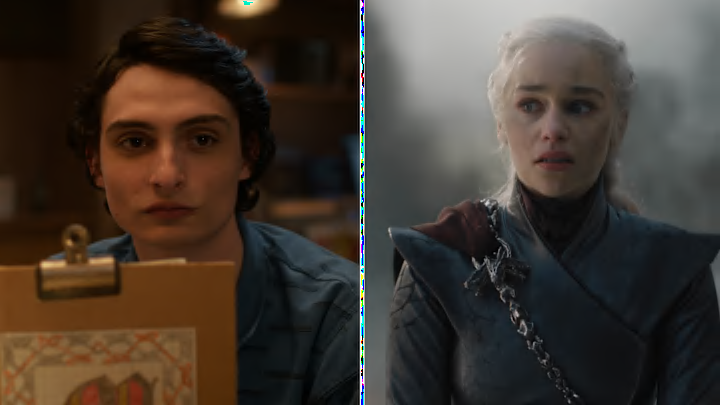
Telling a story is a singular, subjective experience. In ways big and small, conscious and unconscious, any given story is going to reveal a great deal to the audience about the storyteller themselves. The very way that you construct a sentence is going to inherently house a combination of both influence and instinct; showcasing both the inspirations that you aspire to be like and the formative experiences which molded your instincts. The result is a unique kind of alchemy that can prove incredibly difficult to replicate. That’s why so often, there is such a palpable disconnect between the work of the original creator and new voices attempting to mimic it. Whether it be Star Wars or Game of Thrones, seeing overarching franchises suddenly shift from work created by the originator to work created to imitate the originator often results in a distinct sense of dissonance.
But sometimes, the storyteller in question doesn’t even have to change; it can still be the same storyteller, just influenced by a whole new host of potential inputs. For example, the showrunners of a series like Westworld were actively invested in the fan theories surrounding the show and even integrated several of them into the story, or sought to change their story altogether if a theory hit too close to home. Now, with the new Netflix documentary One Last Adventure: The Making of Stranger Things 5, it has been revealed that Stranger Things creators, the Duffer Brothers, were also reading Reddit and very plugged into online expectations and theorizing. Which helps to illustrate a key point: they shouldn’t be.

In the past few decades, the internet has changed a lot of the ways in which various industries function. This applies to the entertainment industry as well, with the internet acting as this unprecedented equalizer of sorts. Suddenly, fans wanting to share their own opinion or interpretation of a piece of media had access to platforms that afforded them just as wide of an audience as any professional critic or screenwriter. This led to a massive uptick in the popularity of things like ‘nerd culture,’ and resulted in massive science fiction, fantasy, and comic book franchises taking over the entertainment sphere, as they were uniquely poised to thrive off of these digitally-enabled symbiotic relationships with fans.
For as beneficial as this online ecosystem can be for some fans to get their work seen by people who wouldn’t otherwise, it can also be extremely harmful, especially when it comes to the franchises themselves. The storytellers behind these franchises now have practically unlimited story ideas just a few clicks away at any given time, and in recent years, many have resorted to using these theorizing forums for everything from research to flat-out uncredited inspiration. For blindingly obvious examples of the latter, one need look no further than blockbuster installments such as Star Wars: The Rise of Skywalker (many of the film’s biggest plot points, including ‘Rey Palpatine,’ had been theories circulating online for years prior to the film’s production) or Deadpool & Wolverine (whose whole Chris Evans shows up and the audience thinks its Captain America but then he says “flame on” and it’s actually Johnny Storm, is beat-for-beat identical to a several years-old fan theory.)
Not only is this exceedingly dubious moral territory, in that it's creators literally leeching off of the work of fans, but it’s also just hack. As a storyteller, your job is to tell a story that is unique and singular to you, not to corral the ideas that you read online that you think are cool into the vague structure of a story. Nor is it your job to get cold-feet regarding a plot beat when you see that someone has ‘predicted it’ in online forums, as many have suspected David Benioff and Dan Weiss may have with the final season of Game of Thrones. Compromising the integrity of your story for such an asinine reason as this ensures the degradation of the work’s quality, and that’s how you get the kind of trainwreck that Thrones' final season was. Similarly, with the revelation that Duffers are equally online for various reasons as it relates to Stranger Things, it makes the final season of that show make a lot more sense.
At best, the Duffers were just checking the forums out of curiosity; at worst, they were perusing them for inspiration. Either way, it is letting voices into the creative space that shouldn’t be there and allowing them to influence the story in one way or another. Even glancing at various fan theories is a quick route to analysis paralysis, where a storyteller feels calcified within the confines of the story they’re midway through telling; something that is painfully apparent and on full display in several Duffer Brothers scenes in One Last Adventure.

Meanwhile, a storyteller like Christopher Nolan, who is so off-the-grid he doesn’t even have a cell phone, makes work that is his singular vision. Whether you love it or hate it, it’s hard to argue that Tenet isn’t the most Christopher Nolan movie to ever Christopher Nolan; there were no fan theories being adhered to in any way there, just a storyteller telling their own distinct story. Similarly, someone like Rian Johnson, who is significantly more online that Nolan, still hunkers down and espouses the virtues of isolating one’s self from external opinions when it comes to crafting the story you want to tell. Star Wars: The Last Jedi is the literal antithesis of what the vast majority of Reddit and fan theories wanted after The Force Awakens, and it’s a far more unique and impactful film because of it.
The internet is a powerful tool, one that can be used for good or ill. But as recent entertainment history has taught us, it may be time for storytellers to put down their computers and mobile devices, and steer clear of the World Wide Web, fans, and their various theorizing for the foreseeable future.
 Add us as a preferred source on Google