

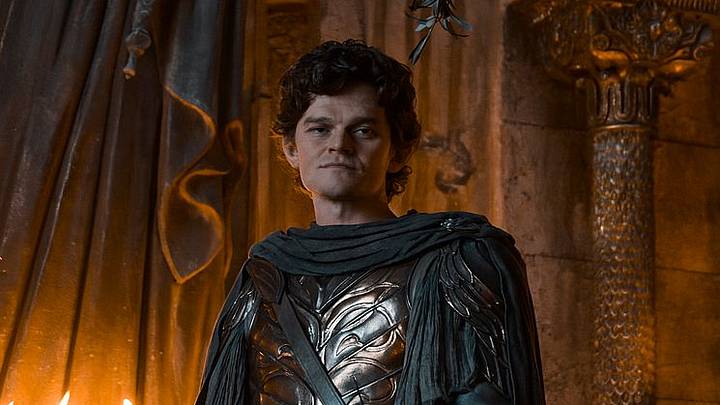
Audiences get a double helping of Aramayo in The Lord of the Rings: The Rings of Power season 3, episode 5, which introduces Elros. Robert Aramayo, who has played Elrond since season 1, takes on both roles in a flashback to a fateful conversation between the two. It’s a moment that, for fans of The Lord of the Rings, has been decades in the making, with Elros never televised before until now.
Moviegoers will know Elrond, played magically by Hugo Weaving, from Peter Jackson’s The Lord of the Rings movie trilogy. Elros, however, was not in the movies. He doesn’t feature heavily in J.R.R. Tolkien’s world-changing novel The Lord of the Rings either, although he is mentioned in Appendix A. The section of that appendix titled “The Númenórean Kings” establishes that Elros and Elrond, the Half-elven (or Peredhil in Sindarin), are the twin sons of Eärendil and Elwing. The Silmarillion, a collection of in-universe myths and tales published after Tolkien’s death, fleshes the story out.

A family tree fit for legends
The king of the hidden city of Gondolin, a First Age gem, was Turgon, and his daughter was Idril Celebrindal. She married Tuor, son of Huor, a hero from the realm of Men. Their son was Eärendil, who was later known for defeating the dragon Ancalagon in the War of Wrath and for bearing a magic jewel called a Silmaril across the skies. So Eärendil, Elros and Elrond's father, was Half-elven, or Peredhel.
Elwing, their mother, was the daughter of Dior and Nimloth. Nimloth was an Elf, but Dior was the son of the human Beren Erchamion and Lúthien Tinúviel, probably the most famous couple in The Silmarillion. Lúthien herself was half Elf, on the side of her father, Elwë Thingol, and half Maia, born to Melian. Melian lost the ability to change her fana (body) after committing to it so thoroughly through childbirth. So, we start to see how Elrond and Elros Half-elven are actually more like Elrond and Elros 56% Elven, but that doesn’t have quite the same ring to it.
Sauron, along with the Istari, including Gandalf, Saruman, and Radagast, are also Maiar. The Maiar are an order of the Ainur, the first-created beings of Eru Ilúvatar, the god of the legendarium. The Valar are the most powerful Ainur, a group that once included all-time baddie Morgoth, although he ended the First Age locked in the Void.
🚨🚨🚨
— Eru Thingol (@EruThingol) September 8, 2026
Primer vistazo a Robert Aramayo como Elros. Ademas parece que tendremos conversaciones entre los hermanos.
Via: polygon pic.twitter.com/uNmVUeiqvZ
The choice of the Half-elven
At the end of the First Age, the Valar gave the Half-elven a choice between the separate fates of Elves and Men. Elrond chose the fate of the Elves: immortality, relatively speaking. Elves’ bodies can die from certain causes, with their souls then heading off to the Halls of Mandos for a possible rehousing.
Men, on the other hand, go in soul form to the Halls of Mandos when their bodies die, and from there they go Eru knows where. An Eru-mandated mystery. Tolkien called mortality the Gift of Ilúvatar. But as The Rings of Power is starting to demonstrate, many struggle to see mortality as a gift.
This may be the main theme of The Lord of the Rings and of the legendarium as a whole. We can expect The Rings of Power season 4 to dive into it even deeper as its adaptation of the Akallabêth, the Númenor storyline, hits full tilt.

The first King of Númenor
Unlike his brother, Elros chose the fate of Men and became a king of the Edain, the noble Men of the First Age. Despite his choice, he was still granted a lifespan far exceeding that of the average human, as were the Edain who followed him. The Edain allied with the Elves to fight Morgoth and were the ancestors of the Númenóreans and the Dúnedain. The Valar rewarded them for their hard work with an island of their own at the start of the Second Age. Elros led them across the sea to the isle of Elenna, and there they founded Númenor.
So Elros was the first High King of Númenor, known as Tar-Minyatur, and his descendants were also long-lived and also mortal. Arwen descends from Elrond and Celebrían. Meanwhile, Elros had four children, from whom both Ar-Pharazôn (Trystan Gravelle) and his cousin, Tar-Míriel (Cynthia Addai-Robinson), are descended. They are known simply as Pharazôn and Míriel in The Rings of Power.
More than 20 generations separate Elros and Míriel, but you can tell she’s pretty happy to see her great-great-(and so on)-uncle Elrond in the show. Ar-Pharazôn, meanwhile, doesn’t seem nearly as glad, being mainly concerned with holding onto the scepter.
The Lord of the Rings: The Rings of Power season 3 is streaming now on Prime Video, with the final two episodes arriving on November 25. Check back as we recap every episode.
 Add us as a preferred source on Google