

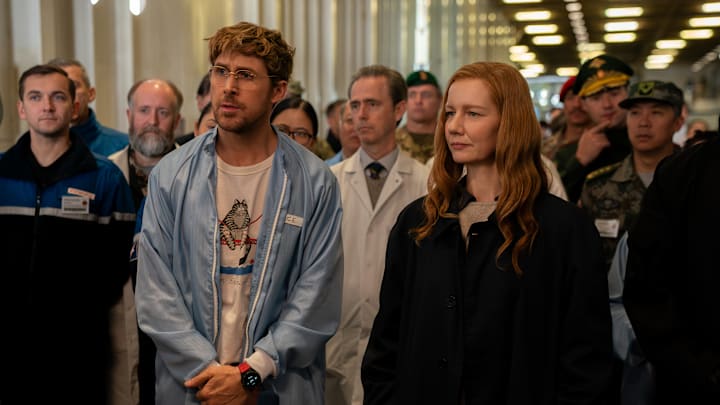
The Ryan Gosling-led sci-fi blockbuster Project Hail Mary has taken the box office by storm worldwide and secured a 95% rating on Rotten Tomatoes. But fans of Andy Weir's beloved 2021 novel know that one of the book's most disturbing and memorable sequences never made it to the screen: the nuclear destruction of Antarctica.
In Weir's novel, the brilliant and ruthless Eva Stratt (played by Sandra Hüller in the film) orchestrates what might be one of the most extreme acts of environmental manipulation in science fiction.
Given unlimited authority to solve the Astrophage crisis that's causing Earth's sun to cool and threatening to wipe out half of humanity, Stratt orders a devastating nuclear strike on Antarctica.
The controversial Project Azrael didn't make it to filming
The plan, known as "Project Azrael," involves detonating 241 nuclear bombs buried 50 meters into a fissure in the Antarctic ice at three-kilometer intervals. The simultaneous detonation drops a massive shelf of ice from Earth's southernmost continent into the oceans, triggering rapid global warming to offset the cooling effects of the Astrophage and buy precious time for the Hail Mary mission to succeed.
It's a morally complex sequence that showcases both the desperation of humanity's situation and the controversial decisions made by those in power during existential crises.
In an interview with SlashFilm, screenwriter Drew Goddard (who also penned the 2015 adaptation of Weir's The Martian) explained that the Antarctica subplot was originally included in his script but ultimately couldn't survive the editing process.
"There's a moment in the book or scenes in the book where they decide they have to nuke Antarctica to buy themselves time on the Earth side of things," Goddard explained. "And it was in there and I loved it. It was such a concept that was interesting and showed the desperation that we were in. But it was just too complicated to explain to an audience within a short period of time and we just didn't have a lot of screen time to take the time to do that correctly."
Goddard elaborated on the practical challenges: "I keep trying to do this in three pages but you have to do this in eight pages and I don't have eight pages to do this. I just don't."
The issue wasn't just about runtime—it was about doing justice to the delicate moral complexity of the scene. Goddard noted that handling such a concept properly "would need the proper space to be handled well, otherwise it could compromise the film."

From four hours to two-and-a-half
The Antarctica scene wasn't the only casualty of the editing room. Directors Phil Lord and Chris Miller revealed on the Happy Sad Confused podcast that their first assembly cut of Project Hail Mary ran nearly four hours long.
"This movie was massive," Miller explained. "When we finally got the assembly cut down to under four hours long, we subjected some filmmaker friends of ours to a three hour and 45 minute cut of the movie, which was embarrassing."
The feedback from their fellow filmmakers was unanimous. Lord recalled, "Get it way shorter."
"You just don't know how the scenes are going to land with an audience," Lord said. "We thought everything was charming, but some of those charming things didn't land."
Looking at Project Hail Mary's critical and commercial success, it's hard to argue with the filmmakers' decisions. The two-and-a-half-hour runtime keeps the story focused on its emotional core, that is the friendship between Grace and Rocky and the themes of empathy, communication and finding where you belong.
As Goddard reflected on the adaptation process, "The soul of the story is empathy and communication. Once we embraced that — the actors, Chris and Phil directing — we realized we had a movie, because we could show how difficult that process really is and take the audience along that journey."
While fans of the novel may miss the audacious Project Azrael sequence, the film that emerged from those brutal editing sessions proves that sometimes less is indeed more, even when you're trying to save the world.
 Add us as a preferred source on Google