

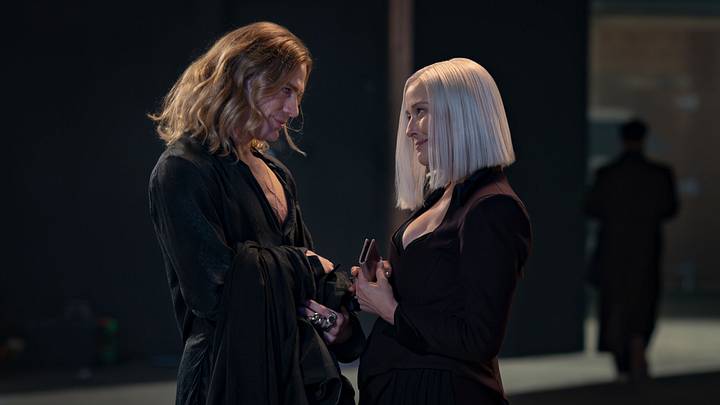
The Vampire Lestat, season 3 of Interview With The Vampire, revealed the foundational moments in the life of Lestat de Lioncourt, whose myriad of emotions Sam Reid inhabits flawlessly. As if on a rollercoaster, the season alternated timelines to investigate how Lestat’s past informs his persona and, naturally, his present. Perhaps the most foundational plot twist occurs as the cliffhanger of episode 1, leaving viewers with the horrific revelation that Lestat’s mother Gabriella Vecce (villainously played by Jennifer Ehle) is alive, a vampire, and in an incestuous dynamic with Lestat.
The titular character narrates the history of their relationship in episode 2. After various attempts, Lestat fails to explain or justify the grotesque nature of the bond, hiding the horrific truth behind an insignificant excuse, the shallow reasoning that human standards do not apply to vampires. Monstrosity — or the blood of Akasha — is often what Lestat hides behind when confronted about the parts of himself he doesn’t like. It’s also a convenient excuse to avoid feeling victimized; better to use immorality as a shield than to face the ugly truth that his own mother is abusing him.
If a small number of casual viewers lamented the continuous incest factor (a stark reminder of the series’ original horror genre), looking closer, The Vampire Lestat unfolded into a story of manipulation and exploitation, a pain as deeply rooted in Lestat as the very scars on his chest. The first red flag is Lestat’s stutter returning the moment he reunites with Gabriella. As it often occurs in real life, it takes bystanders only a couple of interactions to clock the abuse, but it took all season for Lestat to finally see himself as his mother’s victim.

Lestat futilely attempts to rationalize the grotesque by separating his mother from his lover, feeding himself (and the world) the lie that his mother died with her own mortality, splitting her identity from that of Sophia, his 21st century lover. He fails to establish a different parent-child dynamic as maker-fledgling, because the power balance still tips in Gabriella's favor.
The nature of Gabriella’s abusive relationship with Lestat runs deep. To the core, it’s firmly rooted in gender envy: Gabriella sees Lestat as the man she is not and wishes to be. He becomes her foil, the one she projects her aspirations and desires onto. This easily spills into voyeurism and reverse scopophilia. There is no better way to make sense of Gabriella’s relationship with Lestat than to borrow words from Laura Mulvey’s 1975 essay Visual Pleasure In Narrative Cinema, where she uses Sigmund Freud’s psychoanalysis in political terms and writes, “She turns her child into the signifier of her own desire to possess a penis.” For Gabriella, the only way to solve the hand that the universe dealt her is to manipulate her son into her own creature, one she can mold into a male version of herself, own and take pleasure from.
In The Vampire Chronicles by Anne Rice, the books that the show is based on, it is easier to read that Gabrielle (as her character is originally named) experiences some degree of gender dysmorphia, interpreted by some as a trans identity, given that Gabrielle starts dressing as a man after her turning. While this aspect is not entirely made explicit on screen, there are many instances showing that Gabriella is at odds with her gender, first of all, chafing at the marginal role women were relegated to in the 18th century. It’s in the minor victory of being the only reader in the family (and rubbing that into her husband and sons’ faces), it’s in the frustrated way she yells “BE MEN!” at the rhetorical question of what could be done about the wolves plaguing their village. It’s in the way she sees her own face reflected in Lestat’s.

In an age when gender is much more fluid — and talk of binary can't coexist with Lestat's very essence — the season of The Vampire Lestat chooses to directly explore not Gabriella's dysmorphia, but her lack of identification as a mother. Her complete lack of empathy and care even when Lestat's older brothers beat him in front of her shows an utter emotional detachment. She categorically refuses the role the world has impressed upon her, and pursues Lestat as a victim/lover, rather than a son, because she can.
Here is where it gets complicated, though: Lestat does desperately want Gabriella to be his mother, a role she never accepts. He convinces himself to believe that she cares, perpetuates the lie that she wants what’s best for him, that she will love him right, this time. She disappoints without failure, and he justifies it, taking her back in whatever capacity she wants because being abused is better than being alone.
Early in the season, Gabriella’s monstrosity is comforting. Lestat tells himself (and the audience) that he enjoys letting Gabriella lead, being “outmonstered, outbantered.” She is masterful at making it seem like she’s enabling him, making him feel free and loose, instead of manipulating him, stripping his agency away.
The power imbalance comes in when Lestat asks her plainly for their relationship not to be sexual, only for his request to be made fun of, minimized, and firmly denied by Gabriella. Every time he snaps back, she punishes him. When he sets a boundary, she has sex with his body double and makes sure he can hear it. It’s a provocation, to get a reaction out of him, make him snap in jealousy as he did the first time they ended up in bed together, when he was ready to turn his back on her and she convinced him to stay, tied him to her with the only way she knew how: telling him she loved him.
Lestat’s primordial need for connection is so overpowering that he will take anything he can get for a scrap of love, and Gabriella knows to use her son’s fragility to further her own agenda… a gradual plan she sets in motion and carefully works on all season. Cunning as she is, it takes Gabriella no time at all to get back into her son’s good graces and to take his willpower away, to control him like a puppet and exploit him for the Great Conversion.

Yet when they are together, all Lestat can think of is when she will inevitably abandon him again. Like a litany, Lestat demands to know how long Gabriella will stay, alternating this with another mantra: why did she leave in the first place? Halfway through the season, as the ugly truth creeps closer to the surface, he finally asks a different question: “Why do you come back? Why won’t you let me hate you?” This is telling that there is a tiny part of his subconscious that knows their relationship is abusive, but Lestat has always welcomed violence like he deserves it.
Gabriella’s advantage is being intimately familiar with — and perhaps the original orchestrator of — Lestat’s biggest weakness, a haunting loneliness that creeps up on him in her absence. She created it, isolating him ever since he was a child, making herself his only point of reference, all he needs. Because the devil is in the details and this show leaves nothing to chance, this is reflected even in something as simple as the contact cards on Lestat’s phone: Gabriella is “Toi” and he’s “Moi”, you and me, the only two people in the world. “If she died / That would be my death,” Lestat sings in desperation in track 14, "When I Call Out Your Name."
Multiple times, Lestat refers to Gabriella as his great love, even as he recoils inside, putting on a show of proudly leaning into the grotesque even as he unconsciously self-sabotages, begging for the ugly truth to come to surface. It’s only when Lestat allows Louis (Jacob Anderson) back into his life and comes clean that he can finally free himself of Gabriella’s control. It’s only after dissecting his very soul, his life’s worth of failures, that Lestat truly comprehends the enormity of what he’s been through, how his mother’s abuse has conditioned his entire existence, and stands up to her.
Here, Lestat finally understands his life has meaning, and that he is not to be a sacrifical lamb. The pronouns take a whole new dimension when Lestat changes Louis’s contact name to “Lui”, him. Together they can exist in the world, not destroy it to be the only two people left, as Gabriella wanted.

After two centuries, Lestat may have emancipated himself from Gabriella’s yoke, but there is another, meaner mother coming for him: Akasha, the first vampire, mother to them all. The direct sequel to The Vampire Lestat and fourth season of Interview With The Vampire will be titled Queen of The Damned, centering around Akasha (Sheila Atim) and Lestat. Here’s everything we know about the new series so far.
 Add us as a preferred source on Google