

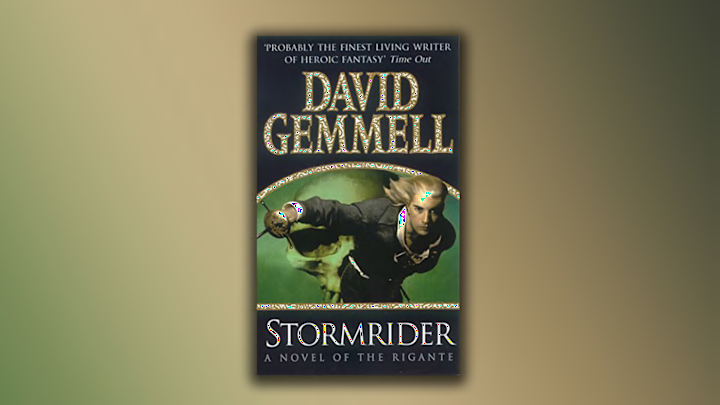
David Gemmell's Rigante series comes to a close with the fourth book, Stormrider. Like its predecessors, it focuses on the title character, which is different in each book.
While there are several interesting secondary characters in this volume, most of the story follows Gaise Macon, who was first introduced in the third book, Ravenheart. Gaise is the son of the Moidart (sort of a governor), a brutal man who showed his son little love through the years.
Magic, which has played a secondary role throughout the series and all but disappeared in the third installment, is much more prominent in Stormrider.
- Book review: Sword in the Storm, book one of David Gemmell's Rigante series
- Book review: Midnight Falcon, book two of David Gemmell's Rigante series
- Book Review: Ravenheart, book three of David Gemmell's Rigante series
Stormrider establishes magic as a factor in the world of the Rigante
Magic played a part in the world of the Rigante in the first two books of the series, but it is fading from the world. In the first book, the Seidh (beings who influence the use of magic) are still roaming the land, within restricted areas, trying to save the world from itself. By the end of the second book, the last of the Seidh have left this dimension of the world.
There is an 800-year gap between books two and three, and magic has all but disappeared in that time. Humankind tends to drain magic, though a few humans can add to it. It is a losing battle, though.
In Stormrider, Winterbourne, a knight, captures an ancient skull that contains the spirit of an evil god of the Rigante named Cernunnos. The ancient, malignant being gives Winterbourne and his fellowship of knights powers above those of normal men.
Cernunnos manipulates Winterbourne to first try to kill Gaise and then to invade Gaise's homeland. The Wyrd, a woman who still maintains a modicum of the old magic, knows in her heart that Gaise is important to the outcome of the war, but she isn't sure how.
Gaise, the Stormrider, returns home to take over the military from his father, the Moidart. Ravenheart brings his small Northern Rigante army to help, convinced by the Wyrd that Winterbourne is far more evil than the Moidart.
The story culminates in a grand battle across several fronts. The fighting is fierce, and deaths on both sides stack up. Ravenheart and Stormrider both show great bravery in fighting Winterbourne's army.
Cernunnos finds a way to manipulate events to remove the skull that contains his essence from Winterbourne's possession and into that of the Moidart. The latter hides the skull without tapping into its power.
Winterbourne discovers the Moidart has the skull and plans to steal it back and unleash the skull's power on the Rigante army. He doesn't understand that Cernunnos wants a body to inhabit. For the old god to regain his power, he must take human form, and the body must be of Rigante blood.
Cernunnos' goal is to wipe out humankind over time, because in every dimension in which humans exist, they have destroyed their worlds.
Cernunnos has no more use for Winterbourne, who fulfilled the spirit's need to be taken to the lands of the Rigante. The ancient god doesn't care what happens in the battle. He just needs a body strong in the Rigante blood.
While this book is outstanding at developing the secondary characters, there isn't the same level of connection to Stormrider that readers felt for the other three title characters. Still, that wasn't the biggest issue with this book.
The level of importance of magic in this final book wasn't actually developed through the series. It was subtle throughout the first three volumes but was much more at the forefront of this story.
Not only that, but a magical occurrence happened toward the end of the book that seemed way out there, and it didn't fit into the overall level of magic established in the narrative. What Gemmell tried to accomplish with this scene is understandable, but it seemed out of place and way out of proportion to the magical baseline established throughout the series.
While the overall narrative of the Rigante was honored in this book, the magical aspect just didn't seem to fit, and it fell flat within the narrative of the series as a whole. Outside the characters who were already part of the story, this book almost seemed like a better fit for a different series.
 Add us as a preferred source on Google