

Even though Game of Thrones strayed more and more from the books as it went on (and eventually went beyond them), season 1 was still pretty closely aligned to George R.R. Martin's A Song of Ice and Fire series. That being said, showrunners David Benioff and D. B. Weiss made a change to the source material in season 1 that Ice and Fire diehards immediately noticed, and it remained in place throughout the live-action adaptation.
In fact, the alteration was so central that House of the Dragon has also been forced to uphold it, despite taking place well over 100 years before Game of Thrones. The prequel has done its best to backtrack on the alteration and reassert Martin's original lore, but it's impossible to fully undo without negatively impacting the HBO franchise. Therefore, I find myself wondering if House of the Dragon's final season will try to seize the opportunity to do so before it ends forever.

Game of Thrones' Iron Throne book change explained
Whoever sits the Iron Throne is the ruler of the Seven Kingdoms, so it is incredibly central to Game of Thrones. It's the very thing that so many are killed or betrayed over. The very image of the regal throne, forged from the swords of those Aegon the Conqueror's forces took down as he united the Seven Kingdoms, has become something of a pop culture icon. However, it's not shown on screen exactly as it's described by Martin in the Song of Ice and Fire book series.
Although it's not completely unrecognizable, the Iron Throne in the HBO show is a streamlined version that worked better for the production for several reasons. In the books, it's routinely described as much larger, looming over the Great Hall to bolster the intimidation factor of whoever occupies it. Furthermore, it's supposed to be a jagged, asymmetrical mess and incredibly uncomfortable. It's made of swords, after all. It's not uncommon for a king or queen to accidentally cut themselves on it.
"“The barbs along the back, the ribbons of twisted steel, the jagged ends of swords and knives all tangled up and melted? It is not a comfortable seat, ser.”"Stannis Baratheon in A Storm of Swords
The intent behind this unconventional design was for Martin to communicate that simply resting easy on a comfortable throne isn't what it takes to rule over Westeros. It should be a painful experience that leaves very little room for relaxation. Aegon fought hard to unite the Seven Kingdoms, and sitting on a chair made of the swords he gathered is a great way for him to posthumously remind his successors of their ongoing responsibilities.
Game of Thrones did its best to honor this metaphor with its version of the Iron Throne, but it was ultimately unable and/or unwilling to build a faithful version of the chair. Factors such as health and safety concerns and budget constraints meant a compromise had to be found. As a result, the Iron Throne in the show is actually quite aesthetically pleasing, and its comfort level isn't addressed as a factor. It's still made of swords, but that's about where the visual similarities end.

House of the Dragon did what it could to make the Iron Throne more faithful to the books
Game of Thrones had already established what the live-action Iron Throne looked like, so House of the Dragon couldn't make any drastic changes. The fact that it's the same chair that has lasted through generations is very important to the worldbuilding. So, the general silhouette of the Iron Throne itself remained the same in House of the Dragon, although it was made a little larger to more obviously dwarf not only the king or queen occupying it, but also those who approach it. It was also made more jagged, asymmetrical, and less like somewhere one might enjoy sitting to unwind with a cup of wine.
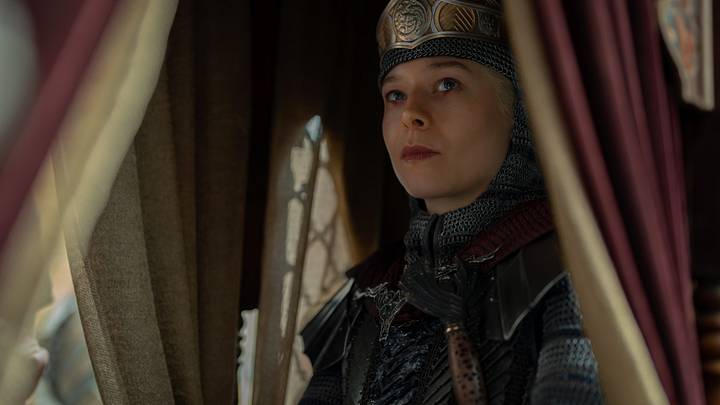
Furthermore, House of the Dragon showcased a much greater collection of twisted swords on display. They run all the way down the steps that lead to the throne, on both sides. This drives home much more powerfully just how many Aegon the Conqueror's forces had to mow down to unite the Seven Kingdoms. Plus, it's a great intimidation tactic. To top it all off, season 3's "Faceless Men" shows Rhaenyra Targaryen (Emma D'Arcy) being cut by the Throne while hearing petitions from the smallfolk. That handles the poor comfort side of things and also restores the poignant metaphor that the Iron Throne is supposed to serve as.

House of the Dragon is running out of time to provide a canon explanation for the Iron Throne change
Obviously it's more for behind-the-scenes reasons than anything else, but it can't be ignored that between House of the Dragon and Game of Thrones, the Iron Throne went through some major aesthetic changes. So, I think there must be an in-universe explanation for this, but House of the Dragon still hasn't provided one. With season 4 now confirmed as the final run of episodes after a period of uncertainty, there isn't much time left to show how, when, and why the Iron Throne was stripped down a little—and where all those extra swords from the steps went.
Although Fire & Blood, the book on which House of the Dragon is based, could arguably be turned to for clues, the books don't change the Iron Throne between eras. So, the Throne is the same as it was during Rhaenyra's time as it is when Robert Baratheon sits there. As a result, all we're left with is vague speculation at the moment. Personally, I think the fighting will make its way into the Great Hall at some point, and the Iron Throne will be damaged and in need of repair. Maybe even the additional swords that adorn the steps will be melted to slag by dragonfire and therefore disposed of.
Of course, there is also the possibility that House of the Dragon will end without ever addressing what is currently a canonical inconsistency. Maybe we're just expected to accept that this is how the Iron Throne has always looked, even in Game of Thrones, and that we just can't see it. I hope not. Either way, if House of the Dragon does fail to clear up this mystery, there are always the decades of lost time between the prequel and Game of Thrones that could be explored at some point—and if not, at least there are enough unseen events to simply assume that something did happen that required the Iron Throne to be altered.
Game of Thrones and House of the Dragon are streaming now on HBO Max.
 Add us as a preferred source on Google