

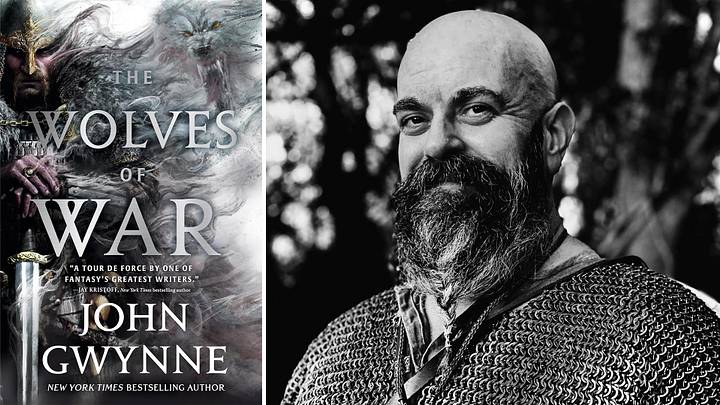
If you read fantasy novels, the chances are good that you've come into contact with the works of John Gwynne. First bursting onto the scene in 2012 with Malice, the initial volume in his hit heroic fantasy saga The Faithful and the Fallen, Gwynne has since carved out a bloody niche for himself as one of the leading authors of modern epic fantasy. He followed that acclaimed series up with two more trilogies: Of Blood & Bone, and the Norse-inspired tale The Bloodsworn, winning the loyalty of readers along the way with his thrilling storytelling, brutally beautiful worlds, and vivid characters that span the spectrum from loathsome villains to valiant heroes and everything in between.
Yet even by Gwynne's own consistently high standards, his latest book, The Wolves of War, is special. Set against the backdrop of a historical fantasy melting pot between Slavic folklore, Viking expansionism, and the cultures caught in its crossroads, The Wolves of War begins a duology called The Wolfheart Chronicles. It is the story of Halia, a brave, physically disabled young woman who discovers she has magical gifts that give her great power... power enough, perhaps, to save her fiercely loyal family from the rising tide of political tensions between the descendants of the north who seek to assert dominance over their lands, the forest tribes which harken back to older ways, and the mythic monsters which loom in the dark spaces between.
Sometimes real-life events can elevate a story from being a well-crafted piece of art, to something with far deeper meaning for how it came into existence, painting extra layers between its words and pages. Having read and thoroughly enjoyed The Wolves of War, I can safely say that is the case here. Gwynne's real-life daughter, Harriett, passed away while he was in the middle of writing his previous series, sending him into an unexpected break between its second and third books as he mourned. The Wolfheart Chronicles is the first totally new story he's developed since, and Halia is very much inspired by Harriett, living with the same disabilities and evoking a piece of her beautiful existence into this world through Gwynne's lovingly crafted descriptions of her character. As the author tells me, "I remember saying to Caroline my wife, if I ever write again, my next writing project will be inspired by Harriett. And this is that book."
We had the opportunity to speak with Gwynne over email about The Wolves of War, his journey to writing the book and how his own family informed the fictional family at the heart of the story, the inspirations behind its fascinating historical milieu, bringing its mythic creatures and legends to life on the page, which fantasy characters he'd want in his shield wall, and more. Read on for our full interview below.

DANIEL ROMAN for Winter Is Coming: The Wolfheart Chronicles is your fourth epic fantasy series. How would you pitch this one to readers, and what sets it apart from your previous works?
JOHN GWYNNE: Hi Daniel, a real pleasure to be here and chatting with you.
Wow, four epic fantasy series. How did that happen? I am in a permanent state of wonder and gratitude that my life and job is to write books.
So, yes, The Wolves of War is book one of my fourth epic fantasy series, The Wolfheart Chronicles.
My pitch to my publishers for this one was Carrie meets The Witcher. At the heart of the story is a young woman who is experiencing the awakening of supernatural powers, so that is the Carrie reference. The world this tale is set in is inspired by Slavic myth and folklore, so the pantheon of creatures is similar to The Witcher, with creatures such as rusalka, leshen, upir, domovoi and a particularly unpleasant striga/witch found within the pages.
The main difference between writing this series and my previous three is that for this series it all started with one character, and I built the world, the story and other characters around her. For my other writing projects, it is the exact opposite. I usually start with the world, then the story, and finally the characters. This book flipped my writing process on its head.
WIC: I loved how deeply you drew on Norse myth and Viking culture for The Bloodsworn, and you’ve done something similar here with The Wolves of War. Except this time, you’re using Slavic mythology with this really interesting intersection of cultural assimilation with Vikings who settled in the region. Can you talk about how you arrived at this milieu for the book?
JG: For all my writing projects I start with a mythology I love, and a historical period that I find fascinating. During my research for the Bloodsworn Saga I read about Vikings sailing not only west to raid Briton and Ireland, but also about Vikings travelling south and east, using the great rivers of Eastern Europe like the Volga and the Dneipr to travel to Byzantium, what is now Istanbul. At that time Byzantium was the richest city in the world and the Vikings travelled there to trade their wares and sell their swords.
I read that Swedish raiders set up a small city-state in the north, calling it Novgorod, and then they expanded south, arriving at Kyiv on the Dneipr River. Here they settled and expanded, Kyiv rapidly becoming their centralized seat of power. It was a crossroad of cultures, which made it fascinating. To the west were deep forests populated by Slavic tribes, to the east were nomad horse-culture tribes of the Steppe, and to the south was the last remnants of the Greco-Roman Empire of Byzantium.
Reading about these historical times and also the Slavic beliefs and mythology of the 10th Century lit a creative spark within me.

WIC: This novel pulls in some very cool creatures from Slavic myth, like rhusalka and leshen. Was there any specific monster you were most excited to include in the story, and why?
JG: I love all of the creatures I have included in The Wolves of War – I grew up on the Ray Harryhausen films and have always loved creature-features, so coming across the Slavic world of folklore and mythology was like finding a new cave full of treasures. If I were to choose one creature out of the long list of very cool monsters, I would have to go for Baba Yaga the striga. She is like the OG of witches. Possibly the first serial killer, and I think the inspiration for the Brother’s Grimm’s child-eating witch in Handsel and Gretel.
Once I started researching Baba Yaga I knew very quickly that I would be writing a particularly unpleasant witch into this new story.
WIC: I know when it came to writing The Bloodsworn, you had a lifelong fascination with Norse myth and Viking culture — including your experience as a Viking re-enactor — to draw from. Were there any influences or references that were especially helpful to you in writing The Wolves of War?
JG: Yes, absolutely. I have a deep love and fascination for wolves, and wolves are such a deep-rooted part of Slavic culture. They are a totemic animal for Eastern European culture. I’ve always written wolves into my stories, but this series takes that to a deeper level. Also, I’ve grown up on horror stories of witches and forests and been enthralled and fascinated by them, and this book was the perfect project for me to explore that fascination.

WIC: You’ve talked before about the difficult period you and your family went through, losing your daughter Harriett, before you wrote The Fury of the Gods, the final Bloodsworn book, and how coming back to that world when you were finally ready felt like a “dam bursting” as the words spilled out. What was the writing experience like for you with The Wolves of War?
JG: Yes, losing my daughter Harriett has changed everything. There are no words to adequately express the horror of losing your daughter, or for my sons the horror of losing their sister. In many ways losing Harriett broke us all, and we shall never be the same. Life will never be the same. Somehow, we have managed to learn to live with the pain – it never goes away, you never ‘come through it.’ Grief is a dark shadow lurking in my soul. A permanent presence. But I can function again now. For a long time after Harriett died I could not function. I stopped living. I couldn’t write, I did not watch TV or read or listen to music. Everything lost its joy. I remember saying to Caroline my wife, if I ever write again, my next writing project will be inspired by Harriett. And this is that book.
WIC: I wanted to ask a few more questions along those lines. Halia, who you’ve said was written as a tribute to Harriett, is obviously the standout character of this book. It feels like you stretched into new territory as a writer to portray how her physical struggle clashes with her deep interiority, often by flipping between her perspective and her father, Ivan’s. How did you approach bringing Halia to life as a character, and deciding which perspective to use when?
JG: I’m so, so pleased that you enjoyed Halia. She is deeply inspired by my Harriett. Both are disabled, cannot speak, suffer with epilepsy. Writing Halia was a joy. I did shed many tears during the writing of her, but also smiled so much, just from the act of focusing upon so many memories of Harriett and her qualities. My goal was to share those qualities with the world. Harriett’s smile, her deep joy in the face of constant discomfort and hardship. Her resilient courage. Her mischievous, infectious sense of humour.
As for writing the Points Of View of Halia and her father, Ivan, I felt this was a rounded way to show how disability affects not just the person with the disability, but also those around her who love her. Much of my writing relies on gut-instinct, and that was very much the case when deciding how and when to write both Halia and Ivan’s chapters.

WIC: In regards to Ivan and his family group, correct me if I’m wrong, but I couldn’t help but notice that it has the same makeup as your own family (plus Root, of course). At what point did you know you wanted to put that into The Wolves of War, and how did it feel to have such a clear analog at the heart of this book compared to some of your previous works? And what was the response in the Gwynne household to this book?
JG: Haha, yes, you are absolutely right. It was not my first intention to write characters inspired by myself, my wife and my sons into this book. But the more I wrote Halia’s character, the more it felt uncomfortable to me to be writing other characters as her parents and siblings. So we all crept into the book. Of course, all of them are only characters inspired by myself and my family, but this approach sat much better with me as I wrote the story. My wife and sons have loved that I have done this, and there are quite a few family jokes that are included in the story, such as one of my son’s deep love for milk (he is a dairy farmer in the real world).
WIC: Root the domovoi is a very fun character who plays an important role to the story and to Halia personally. Between her, the rhusalka, and your previous work in The Bloodsworn, you’ve created a pretty consistent streak of writing vividly compelling non-human characters. Is there anything in particular you try to keep in mind as you approach them in order to differentiate them from the human characters in your novels?
JG: Thanks so much, Daniel, I’m so pleased you feel this way. I loved writing Root. In my reading experience I’ve always loved animal or creature companions and characters. Huan from The Silmarillion, Gurgi from the Book of Three, and of course Nighteyes by Robin Hobb. So these kind of characters have always featured heavily in my own writing. I suppose the main thing I keep in mind with them is that they are sentient, with feelings and emotions, and I try to balance that with their animalistic traits, whatever they might be. Most of them revolve around food – in some cases human teeth as food.

WIC: The Fury of the Gods was an outlier in that it was the first time in your writing career you had a longer multi-year break between books in a series, for the obvious reasons we talked about above. Do you anticipate The Wolfheart Chronicles getting back to the annual release cycle you used in the past, or will there be more time between books this time around?
JG: The Wolfheart Chronicles is definitely back up to speed for me. I have already finished book 2, which is the last book of the duology, and submitted the first draft to my editors on 14th October. So the series is finished before book 1 is published. That’s the crazy world of publishing for you. Of course there are a few stages of editing to go on book 2, but the hard work is done and I don’t see any reason why it won’t be published in the Autumn of 2027. And I am working on my next writing project – I can’t say anything about that right now, as I haven’t pitched it to my publishers yet, but hopefully that will change fairly soon.
WIC: Is there anything you’re reading right now that you’re particularly enjoying and think your readers would also like?
JG: I have just finished Iron Gold by Pierce Brown. It is a masterpiece, truly a phenomenal book, and right now I’m reading two books – The Thrice Bound Fool by Christopher Buehlman, and Children of Gods and Fighting Men, by Shauna Lawless, both of which are brilliant so far.

WIC: Last question! If you were to assemble a fearsome band of warriors to try to find Perun’s Chamber and its mythically powerful thunderstones, but you had to choose your party members from other works of fantasy outside your own, who would you want at your back?
JG: Haha, love this. Okay, lets go.
Gabriel de Leon form Jay Kristoff’s Empire of the Vampire. He has pretty cool powers, but his loyalty to his friends is his greatest strength.
I want to choose a Joe Abercrombie character, but I’m not sure if I’d trust any of them in the shield wall. I’d like to say Viga from The Devils, but that would go badly wrong. Is there anyone else I would trust? I don’t think so. Ah, yes, there is one. The Dogman. What a guy. I love that guy.
Princess Donut from Dungeon Crawler Carl. She would be strategic advice, and some explosive firepower.
Nighteyes, the hunter-tracker.
Gimli. Any dwarf would be awesome in a shield wall.
The Viper from A Song of Ice and Fire. He knows how to use a spear.
Derfel Cadarn from Bernard Cornwell’s Warlord Chronicle. A skilled swordsman with excellent weapons-craft and shield-work. And the man I’d most like to have a pint with.
As you can see, I haven’t thought about this much at all.
WIC: Amazing. John, thank you so much for stopping by the site to talk about The Wolves of War!
JG: Thanks so much, Daniel, it has been an absolute pleasure chatting to you. I wish you happy reading.
Head and Heart,
John
An enormous thank you to John Gwynne for taking the time to dive deep on The Wolves of War with us.
The Wolves of War by John Gwynne is available now from Orbit, wherever books are sold. You can read our review of the book here.
 Add us as a preferred source on Google