

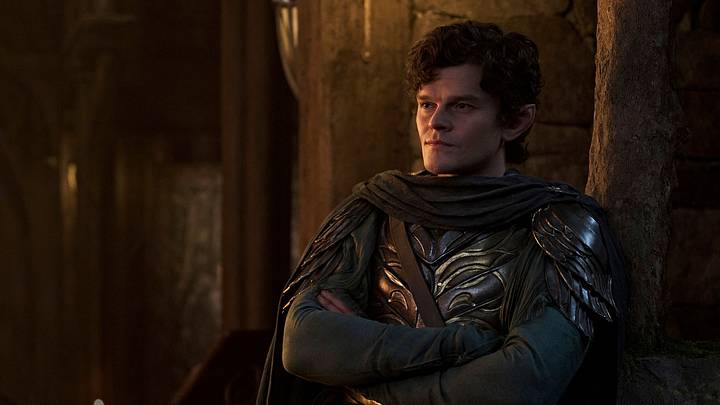
While we may only be into the second week of The Lord of the Rings: The Rings of Power's third season, somehow we're already speeding past the halfway point in the story. Episodes 5 and 6 are now streaming on Prime Video, carrying us from the dread halls of Gundabad out into the impenetrable forests of the Greenwood, the island palace of Númenor, and the vast deserts of Rhûn.
Following the devastating ending of episode 4, Galadriel (Morfydd Clark) and her husband Celeborn (Jamie Campbell Bower) have been reunited for the first time in centuries, only to end up on the run from Sauron's (Charlie Vickers) Orcs. In Rhûn, Gandalf (Daniel Weyman) confronts his fellow wizard Pallando (Ciarán Hinds) in an attempt to seer him back toward the light. And on the island of Númenor, the Elves Elrond (Robert Aramayo) and High King Gil-galad (Benjamin Walker) try to secure an alliance that will give them an advantage over the Dark Lord's implacable armies.
Despite heavily featuring several locations, there's a focus to episode 5 that keeps The Rings of Power humming right along. Let's recap and discuss. FULL SPOILERS for the episode beyond this point.

Sauron's unstoppable will
Episode 5 begins with a cold open revealing that Marnûkh (Adam Young) survived the battle at Gundabad, and has been taken prisoner by Sauron. Galadriel and Celeborn have somehow managed to evade him with the help of their eagle friend, and Sauron is quietly determined to find out where they went. The catch is that Marnûkh is an expert torturer. He's not likely to crack under any physical duress.
And so Sauron does the thing he's always been so excellent at: he gets inside Marnûkh's head. His speech about the way others view Orcs, leading into the reveal that he knows about Marnûkh's five children, is yet another perfect example of Charlie Vickers being excellent at playing outrageously evil. Threats to his children are the one thing Marnûkh can't abide, and he tells Sauron everything about Galadriel and Celeborn's plans. Of course, Sauron has already killed Marnûkh's kids, and has no intention of letting him join them in death. Instead, the Orc will remain alive so that he can experience becoming utterly subservient to Sauron once the One Ring is complete.
Normally, I get annoyed with that age-old trope where the villain has someone captured, and then just decided to let them live. It often smells like plot armor. But in this instance, it fits so well with Sauron's MO that it's easily forgivable. Simply killing an enemy is boring to an eternal being like Sauron. Forcing them to obey his every whim is far more fun.
Sauron sends his Orcs on the hunt for Galadriel and Celeborn, and we get one brief interaction between him and Theo (Tyroe Muhafidin), where Theo asks when he can use necromancy to speak to his mother. "Be not a fool, my servant," Sauron replies, leaving Theo gazing at the nearby brazier, where Arondir's breastplate burns. I love how Sauron dismisses his request, but in a way that exudes far more respect than the way he speaks to most anyone else. There's a feeling that he's not being cruel to Theo, he genuinely believes nothing helpful will come of it. Sauron remains an utterly fascinating villain in this show, and his handling of Theo a highlight.
We don't see any more of Theo in this episode, and only a tiny bit of Sauron near the end, but that's alright because we've got other things to occupy us: like Númenor.
We've had one Robert Aramayo, yes. What about *second* Robert Aramayo?#RingsofPower #tropspoilers #elrond #elros pic.twitter.com/2WDWlsZAR6
— Jokien With Tolkien (@JokienWTolkien) September 8, 2026
Elros' choice
Following the opening credits, the fifth episode of The Rings of Power season 3 brings us into a flashback to the First Age which reveals a foundational piece of lore for Elrond, and his twin brother Elros. Did you forget Elrond had a twin brother? Understandable! He's only been mentioned a handful of times in the show so far, and always in a way that made it clear the series was waiting for the right moment to reveal the full details. That time is finally here, along with a somewhat amusing wig for Robert Aramayo, who deftly plays both Elrond and Elros.
The scene in question depicts the final meeting between Elrond and Elros, where Elros reveals to his brother that he has chosen to become a mortal and found the island kingdom of Númenor. This is deep, First Age Tolkien lore, and I love that The Rings of Power leaned into it. The quick gist is that Elrond and Elros are both of mixed blood, with Elves and humans in their family tree. Following their valor in the War of Wrath, the pair were given the choice to stay as immortal Elves or choose the "Gift of Men," a.k.a. mortality. Elrond, obviously, chose immortality. Elros chose to become the leader of Númenor, helping build the strongest nation of Men the world of Middle-earth will ever know.
Aramayo does a solid job here of playing both siblings, as well as all the complicated emotions that go along with this meeting. Elrond feels he's already lost his brother, because the life of a mortal is a blip to a timeless Elf. Elros is exhausted from the war yet optimistic for what Númenor could become.
The scene itself is enjoyable and a total treat for Tolkien enthusiasts (so long as you can get past the wig, which I admittedly struggled to do on my first watch), but the greater boon that the Elros scene brings to the episode is that it adds a ton of weight to Elrond's journey to Númenor in the present, helping us understand why this place has such meaning to him, and he to it.

The diplomacy of the Elves
Númenor has grown strong since the long-gone days when Elros founded it, but its spirit has also changed as well. Elrond and High King Gil-galad arrive there in hopes of convincing Ar-Pharazôn (Trystan Gravelle) to join his strength to theirs, so that together they can put a stop to Sauron's reign of terror. From the jump, the episode drives home what a fraught affair this is for Elrond in particular, because not only is he absorbed with thoughts about whether Númenor is living up to Elros' vision, he's also viewed as an almost mythic figure by the people there, since he and his twin brother's faces look exactly alike and the Númenóreans have many depictions of their founder.
The first of these interactions happens as Gil-galad attempts to initiate negotiations with Pharazôn, only for everyone in the room to be distracted by Elrond. It's a nice touch that while Gil-galad tries to come to Elrond's defense when Lord Belzagar (Will Keen) wants to touch his face, Elrond himself seems to understand the full gravity of what his presence on Númenor means for the people there, and patiently allows it.
Everything about this scene and the following dinner is a power play, every line loaded, every interaction meant to bolster either the Elves or Númenóreans' position in this deceptively informal meeting. Walker and Gravelle especially do amazing work as Gil-galad and Pharazôn, capturing the prickly interplay between two kings who are not used to treating with other equals.
Pharazôn does want to join the war against Sauron, who he looks down on as an upstart "blacksmith" with no claim to any sort of rule — which is somewhat ironic considering that Sauron is a Maiar, essentially a demigod in this world, though Pharazôn does not seem to fully grasp that. However, the king of Númenor cannot join the fight while his own nation remains divided. If Gil-galad were to back him as the one true king, denouncing Míriel's Faithful, it would solidify Pharazôn's position and free him to head for Middle-earth.

The Elves are understandably hesitant to get involved in Númenor's civil war, especially considering that they had a much better time dealing with Míriel (Cynthia Addai-Robbinson) in season 1 than they have thus far with Pharazôn. Gil-galad has another solution: for Elrond, the master negotiator and venerated brother of Númenor's founder, to find some way to bury the conflict and unite the divided empire.
This is a lot to ask of Elrond, and he decides to walk the city to think about how best to approach it, hoping that he'll feel some connection to his dead brother that will guide him. That connection comes in the form of Isildur (Maxim Baldry). Elrond ends up at a shrine where he thinks about Elros, while Isildur sits nearby, lost in his own spiraling thoughts about his dead sister, Eärien (Ema Horvath). The two have a beautiful conversation about loss and searching for meaning in what's left, which includes some of the strongest dialogue of the episode. When Elrond reveals who he is to Isildur, it's a heartwrenching moment in the best way.
Isildur takes Elrond to see Tar-Míriel, where we get a brief but beautiful interaction as this blind leader takes in what she can of Elrond's face and how it differs from his brother's — including his pointed Elf ears. She wonders if Elrond has come to lead the Númenóreans into battle, setting up the ending cliffhanger that Elendil (Lloyd Owen) and his army of Faithful are about to attack a force of King's Men.
Overall, Elrond's story in this episode might be one of my favorite parts of the season so far. The extra layers that his past with Elros add to everything going on in Númenor is fascinating, and exactly the sort of depth I want out of a show where half the cast has been alive for millennia and has to navigate how that intersects with the mortal races around them. There are occasional awkward spots, like when Pharazôn gripes about Sauron's hair, and the fact that the armies are seemingly out in the middle of the countryside, raising questions about why exactly anyone is fighting there in the first place. But overall they're easy to forgive for how meaningful and compelling the vast majority of Númenor's story is this episode.

Galadriel and Celeborn, reunited
While Elrond is in Númenor, Galadriel and Celeborn race through the Eryn Galen, where they planned to link up with Arondir's (Ismael Cruz Córdova) kin and give Sauron the slip. From the cold open where Marnûkh gives up their location, it's obvious things aren't going to pan out. That gives this whole flight an extra layer of tension, as Galadriel and Celeborn test the waters of communicating with one another while Orcs are hot on their tails.
The chemistry between Morfydd Clark and Jamie Campbell Bower can't be understated. These two are so easy to watch on screen, and the casting department totally nailed them as the best-looking and most natural Elf couple you may ever see in a TV show. My only regret is that by the end of the episode, they're separated once again.
Celeborn serves as an interesting counterpoint to Galadriel. While her traumas hardened her to the point where she became a relentless warrior consumed by her own anger, Celeborn was forced to find joy in the smallest things just to survive his daily torments in various Orc prisons. It's pretty much the opposite of what you'd expect from a character who's been locked away for centuries, and it continues the theme of Bower's performance landing like a breath of fresh air. I especially liked the story about how Celeborn grew to know his torturers, then the generations of their children, before he foolishly showed them a lock of Galadriel's hair and they burned it, shattering any feigned friendship between them.
There are a few important bits of information in this section. The first is how Celeborn survived when Galadriel and everyone else thought he had died in the First Age. During a battle late in the War of Wrath, Celeborn's legion was set upon by a dragon known as Ancalagon the Black, who burned the entire host to ash. Only Celeborn survived, by getting accidentally kicked into a ditch by a horse, where the water protected him. When he emerged, he was surrounded by the enemy, and taken prisoner. We find out later that it was none other than Sauron himself who was riding Ancalagon during this battle, and therefore gave the order to burn Celeborn's legion.
The second is where Celeborn ended up: Thangorodrim, the mountain fortress of the Dark Lord Morgoth. He remained a prisoner there until it fell. It isn't mentioned in the episode, but ironically, in Tolkien's legendarium Thangorodrim falls near the end of the war when Ancalagon is finally slain, and crashes down onto the fortress.
We don't spend any time on that interesting but ultimately unnecessary bit of lore though; instead, the episode focuses on the idea that Galadriel was also at Thangorodrim when it fell, fighting on the ground. She saw Celeborn there, and he saw her. Yet while he called to her for aid, she assumed he was a vision sent to haunt her, as she used to see shades of Celeborn everywhere in those early days after their separation. Besides, she was on the hunt for Sauron, and nothing was allowed to stand in her way.

While I did like the little tidbits of First Age lore sprinkled throughout this section, the idea that Galadriel literally saw Celeborn and ignored him feels a bit too on the nose. The show clearly wants to play up the idea that she couldn't slow down long enough to search for her presumed-dead husband because she was obsessed with hunting Morgoth's last surviving, lieutenant, Sauron. And while I do like that idea in theory and the show has often executed it well, here it all feels just a little too contrived. If Galadriel hadn't seen Celeborn, but he her, I don't know that this sequence would have lost anything.
True to all the kindness he's shown so far, Celeborn does not hold this against Galadriel. The two end up making up, kissing, and sleeping together in the trees while the Orcs scour the ground below. Bear McCreary's score does an amazing job of upping the emotion in all of these scenes.
Galadriel's rest is cut short by a dream of Sauron, which sends her tumbling out of the tree to the forest floor below, alerting all the Orcs. Rather than let his unconscious wife be captured, Celeborn jumps down and draws their attention, saying he's alone in the forest. The Orcs, however, are not alone; Sauron arrives swiftly on his fell beast, and confronts Celeborn in person. "She'll come to you...she'll come for me," he taunts the Elf, taking him captive.
Celeborn managed to stay free for roughly one day, but his sacrifice kept Galadriel out of Sauron's hands. By the end of the episode, the lovers are parted once more. Good thing we don't need to wait until next week to see what Galadriel does next, since episode 6 is already out!

Wizards in Rhûn
The last piece of episode 5 is the shortest, and it takes place in Rhûn. The blood moon has arrived, and the vast army of Rhûn has assembled around the stronghold of the Dark Wizard, a.k.a. Pallando (Ciarán Hinds). This is the sign Gandalf has been waiting for, and he approaches this fellow servant of the Secret Fire in hopes of finding some way to talk him down from his plans to join Sauron.
Stepping into the role of a character like Gandalf, who was performed so iconically by Ian McKellen in Peter Jackson's Lord of the Rings films, is a gargantuan task, but Weyman meets it brilliantly. There's a cheerful air to the way Gandalf operates, which is necessary considering that his motus operandai is to "save" Pallando by reminding him he can still fight for good.
Of course, Gandalf doesn't account for Khamul the Easterling (Zubin Varla) being in the mix, and the pressure the Nazgnagôl's presence might exert on Pallando. The former Blue Wizard ends up attacking Gandalf after revealing that the Secret Fire told him that he would die at the hands of a Nazgnagôl, and Gandalf at the hands of Sauron. Gandalf refuses to fight back, and is ultimately subdued to be delivered to Sauron. When last we see the Wizard, he's strapped to the back of an oliphaunt as the vast armies of Rhûn march to war.
The Wizard fight itself is one of the weakest parts of the episode. While Hinds, Varla, and Weyman all do solid work with the energy they bring to the scene, the fight hews a bit too closely to Gandalf's duel with Saruman in The Lord of the Rings, with Pallando throwing Gandalf about with his staff and pinning him to the walls and ceiling. Do Wizards, with their expansive magical gifts, truly not have any other ways to fight each other? It feels like a massive missed opportunity where The Rings of Power could have created its own very memorable Wizard scene, but instead fell back on recreating something from Jackson's films in an inferior way. That tendency remains The Rings of Power's greatest weakness.

Verdict
The fifth episode of The Rings of Power season 3 feels very much like a bridge episode, ending with several cliffhangers that lead directly into episode 6. That doesn't detract though, especially considering that Prime Video released them together. The time with characters coming back together is much appreciated here, from Celeborn and Galadriel, to Elrond's reckoning with the shade of his brother, to Gandalf and Pallando finally talking face-to-face. The intricacies of Númenor in particular were a highlight, with Elrond stealing an episode that should have easily belonged to Galadriel and Celeborn. There are a few rough spots, but on the whole this was still an extremely enjoyable episode of television. Onward to the next!
Episode grade: B
 Add us as a preferred source on Google