

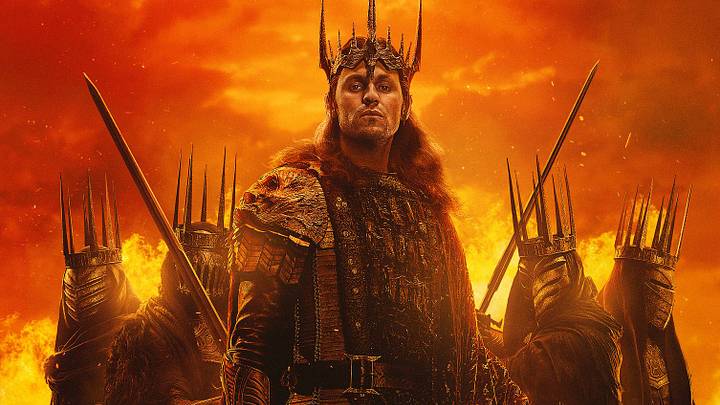
The third season of The Lord of the Rings: The Rings of Power looms near, but when Prime Video's epic fantasy series returns, it will look quite different than it did before. The show's first two seasons told a fairly linear story that followed Sauron's return from obscurity, and the rising threat he suddenly posed to the peoples of Middle-earth as he began manipulating the Elven smiths into forging the titular Rings of Power. Season 3 plunges viewers into the heart of Sauron's reign, when he has full command over the dark forces of Mordor and is waging a vicious war to conquer all those who oppose him.
While there will be numerous ways The Rings of Power has to sell this transition, the most prominent aspect will be the passage of time. And as it turns out, the show is about to tackle it by utilizing the exact same idea that George R.R. Martin once had for his renowned fantasy book saga A Song of Ice and Fire...which he was forced to abandon after it became clear that it wasn't tenable for his particular writing style.
In the process, A Song of Ice and Fire suffered a major setback that delayed books, from which the series has arguably never fully recovered. Can The Lord of the Rings: The Rings of Power succeed where Martin couldn't?

The Rings of Power's five year time jump will be the first test of season 3
If you're familiar with the history of Martin's books or have been following along with Prime Video's Lord of the Rings show, you likely know that I'm referring to the five year time jump that is set to occur between seasons 2 and 3 of The Rings of Power. The show's second season ended with the Fall of Eregion, a major Elven stronghold which was swallowed by the shadow in The Rings of Power's single most ambitious battle scene to date.
The Fall of Eregion marked a major turning point for the narrative, where Sauron was finally unmasked and assumed control of the orcs of Mordor, while the Elves banded together to resist him and founded Rivendell as a sanctuary for their operations. There were other major shifts in the status quo as well, such as the Stranger's identity finally being revealed as Gandalf, Ar-Pharazôn establishing his rule over Númenor, and the Dwarven king Durin III sacrificing himself in an attempt to defeat the Balrog which awakened beneath Khazad-dûm.
All of these plot threads together left the show in a place where including a time jump made a lot of sense. When The Rings of Power season 3 premieres, it will have to get us caught up on all the ways the world of Middle-earth has changed for these various characters and factions in the intervening half decade. Ideally, that will feel different depending on which characters we're talking about; for Elves, five years is nothing, but for Dwarves or Men, it's a significant period of time. And no matter how you slice it, the war for Middle-earth will be in a totally different phase than it was in season 2.
How well The Rings of Power handles this transition will lay the foundation for season 3's success. If the show pulls it off, the season will begin with compelling narrative shifts that automatically draw viewers deeper into the story as they try to adjust to everything that's changed. If it fails, it runs the risk of breaking their suspension of disbelief through small plot holes and inconsistencies. Only time will tell.

A Song of Ice and Fire's planned five year time jump became a major roadblock for the series
This is a rare instance where we have a very clear parallel to examine for the dangers of the five year time jump. In George R.R. Martin's original plan for A Song of Ice and Fire, there was going to be a five year time jump following the first part of the saga. That "first part" of Martin's originally pitched trilogy grew into three books: A Game of Thrones, A Clash of Kings, and A Storm of Swords.
Similar to The Rings of Power, by the end of A Storm of Swords we saw major shifts in the playing field, setting the stage for the impending time jump. Arya Stark sailed to Braavos to train with the Faceless Men. Bran Stark went beyond the Wall with Coldhands to study under the three-eyed crow. Jon Snow became Lord Commander of the Night's Watch, Daenerys Targaryen conquered Meereen, and Tyrion Lannister fled to Essos after murdering his father and former lover. Everywhere you look in the final chapters of A Storm of Swords, there's clear groundwork for characters to stay put for a while and grow into their new roles, which was especially important considering the young age for characters like the Stark children.
However, after spending around a year trying to make the five year gap work, Martin ultimately decided to scrap it and start over with his fourth novel, continuing the story directly from the ending of A Storm of Swords instead. He made this difficult choice because the time jump forced him to rely too heavily on flashbacks and filling in all the blanks about what happened in those intervening years, which he did not think made for a satisfying reading experience. Given Martin's incredible attention to little details, it's easy to imagine how all those missing moments might have added up to become a true headache during the writing process.
The end result turned into A Feast for Crows and A Dance with Dragons, and marked the first long waits that fans had to endure for new A Song of Ice and Fire books. The 15+ year delay for The Winds of Winter is the stuff of legend at this point, but back in the early 2000s, fans were equally frustrated with the five years it took between A Storm of Swords and A Feast for Crows, especially considering the latter largely featured less prominent characters while fan-favorites like Jon Snow, Daenerys Targaryen, and Tyrion Lannister sat things out for another six years before the release of A Dance with Dragons in 2011.
Ultimately, we'll never know exactly how Martin's decision to can the five year gap in A Song of Ice and Fire impacted the series as a whole. But I think it's fair to say that it completely killed the momentum on the saga, which had previously seen new books release every two years. Martin's book series has never truly recovered that momentum, and whether he'll ever complete it feels very much like an open question at this point.
When we look back on the overall story of how A Song of ice and Fire was written, the difficulties with pulling off the five year time jump and how it forced Martin to completely rework the story remain a significant factor in the difficulties that it faced for years afterward.

The Rings of Power has already conquered the time jump problem
Fortunately for fans of The Lord of the Rings: The Rings of Power, the good news is that television is a very different medium than writing novels, and the gargantuan machine of production keeps on rolling. Showrunners J.D. Payne and Patrick McKay have already done what Martin could not with their series by completing season 3, time jump and all. Regardless of whether they executed this narrative leap flawlessly, the fact remains that they did execute it, and soon we'll be able to watch a whole season of television that incorporates it.
If and when Prime Video renews The Rings of Power for season 4, it's likely that all the kinks in the time jump will have already been thoroughly worked out. In doing so, McKay and Payne's Lord of the Rings series has already set itself up to succeed in this daring endeavor.
The Lord of the Rings: The Rings of Power premieres its third season November 11 on Prime Video. As for The Winds of Winter, our watch continues.
 Add us as a preferred source on Google