

The fourth episode of Mike Flanagan’s Carrie TV series on Prime Video is titled “Dramatic Arts” and is written by Dani Parker and directed by Axelle Carolyn. With its final moments serving as the exact midpoint of the series, “Dramatic Arts” acts as something of a waypoint through which to evaluate the relative success of the show thus far. In adapting Stephen King’s iconic novel to the small-screen and striving to flesh out the fairly short book into something that can sustain a full eight hours of runtime, many creative liberties have been taken within the confines of the story of Carrie. The question is, does it all feel worth it? To that, I think the answer is an unequivocal yes, as Flanagan and co. have continuously delivered fascinating work, even when it doesn’t all quite coalesce in the ways it feels like it should.
What exactly am I talking about? Well, the start of “Dramatic Arts” is good place to begin this conversation. Every episode of Carrie thus far has had a cold open in which Kate Siegel (who is involved in the series as an actress in a currently unknown role and a director) narrates over the top of some documentary-esque footage, detailing an incident of telekinesis or supernatural abilities. The purpose of this seems to be to pretty blatantly expand the scope of Carrie’s story. The idea that other characters with telekinetic abilities are going to be or are already involved in the mainline story has been teased time and again (in increasingly obvious ways, to the extent that I’m no longer entirely sure how much of a ‘twist’ one character’s secret is even supposed to be to the audience), and the cold opens serve to further that in-narrative world-building while also laying the groundwork for what is to come with Siegel’s character, one would assume.
This is neat, and I hope to find it all the more valuable in hindsight, but I can’t help but feel like these aren’t really delivering on the promises of the initial episode’s cold open. That scene features Siegel’s character (off-camera) interviewing Sue Snell (as played by Siena Agudong) in the aftermath of the climactic prom night sequence, and was an idea pulled directly from King’s novel, whose structure is akin to a proto-found-footage style, where the author is interweaving present-tense action with past-tense accounts from eye witnesses and newspaper reports. Bringing this into the modern era to serve as a larger framework for this iteration of Carrie seemed like a great idea, but the series has entirely eschewed this angle. The subsequent cold opens have all been about other people and events, disconnected from this story, and the series has not returned to this kind of approach at all, which I wish it would.

Carrie episode 4 review: "Dramatic Arts"
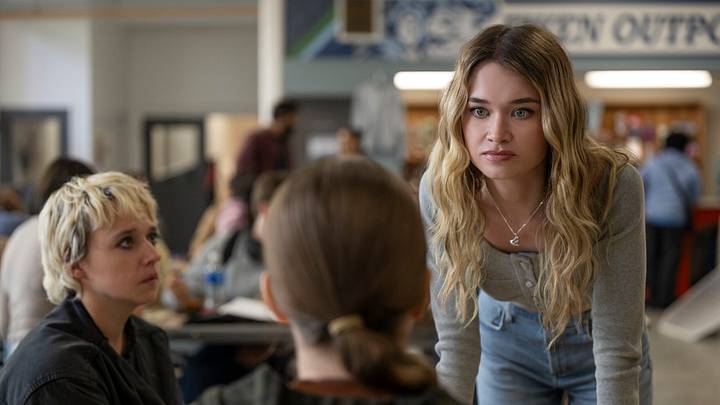
The bulk of the narrative of “Dramatic Arts” is essentially a riff on Mean Girls, which is not a derogatory remark (Mean Girls absolutely rules and is a generational film at this point) but rather just a neutral statement of fact. The episode opens with Chris Hargensen (as played by Alison Thornton) having gotten her mean-spirited ‘CarrieRed’ Instagram account to go viral, with bullying posts relating to different students, teachers, and beyond. The thing spreads like wildfire across the school, turning people against one another and further upping the tension of the already contentious atmosphere. Parker’s scripting does a great job of showcasing the large-scale causality of all of this, interweaving public-facing performative reactions to a given post with the more interpersonal, behind-closed-door responses.
It all works well, is a great tone-setter to kick off this episode, and also seems to reveal a bit more about the long-term trajectory of the series’ larger narrative. But I’m not sold on the idea that this is necessarily for the best. In the novel and prior iterations, Carrie’s isolation is a focal point of the story. She is specifically targeted by bullies and routinely mocked and ridiculed by her fellow classmates, which is certainly a simpler take on all of this, but it’s also a more effective one. Having ‘CarrieRed’ bully the whole school openly and often equally detracts from specific emphasis on Carrie as a character, and instead turns it into a much more systemic problem. I’m still more than keen to see where this all goes, and the conclusion of this episode certainly hints that future episodes will dig a bit deeper into Carrie’s ostracization, but it just seems to be a choice that does pull focus from the real meat of this story.
Having said all of that, there are some individual strengths in “Dramatic Arts” as a singular episode that really stand out and make it among my favorites of the series to date. Axelle Carolyn has a firm grasp on both the interpersonal character interactions and on the more fantastical horror elements. For example, the idea of turning Carrie’s frequent walking through the streets of Chamberlain into a recurring motif that will inevitably build to her destructive walk in the climax of the series, as Carrie’s own visions have shown the audience multiple times at this point, is a great one. I also must applaud Carolyn’s use of split-diopter shots (the first of the series!), which are great and of course feel like deliberate odes to Brian De Palma’s, whose iconic 1976 take on Carrie is chock-full of such unique compositions.
“Dramatic Arts” features two of my favorite scenes from the series thus far, as well. First off, the scene in which, after learning that her mother has not gone to pick up her father’s cremated ashes, Carrie confronts Margaret is absolutely phenomenal. The push-and-pull of this mother-daughter relationship has consistently been a strong point of the series, thanks in large part to the incredible performances of Summer H. Howell and Samantha Sloyan, respectively. But another gargantuan part of the equation has been the articulation and nuance with which Flanagan and co. have turned this often binary relationship into a much more complex organism. The shot in which, after Carrie has chastised her mother and told her that she is failing to actually let her father rest in his death, Sloyan reacts over the course of 10 seconds is absolutely astonishing. Her reception begins with what looks like an understanding before mutating into something deeply wounded and vindictive, and it’s just incredible to witness. This scene as a whole is just so strong, and it’s what I hope to see more of out of the show moving forward.
Elsewhere, the horror sequence in which Carrie falls into the ditch at the construction site where her father died, after Hargensen has maliciously taken her out there under false pretenses, is the best genre-centric stuff the show has yet to offer. I need to clarify here that I am not opposed at all to the series taking its time to really earn the horror that is undoubtedly coming in the latter episodes; having the discipline to really endear audiences to these characters before cranking the volume up in this way is a testament to the creators’ strengths. But this sequence was a visually inventive, character-rooted piece of horror and having it culminate in Carrie’s largest telekinetic outburst to date made it feel all the more explicitly tied into her larger arc in the best of ways.
Verdict
“Dramatic Arts” is a really good episode of Carrie, even if it does hint at some increasingly befuddling trends for the series as a whole. In isolation, it features some of the strongest work of the series thus far, with great performances, strong writing, and stellar direction. Turns out, Carrie-meets-Mean Girls ain’t half bad.
GRADE: B-
 Add us as a preferred source on Google