

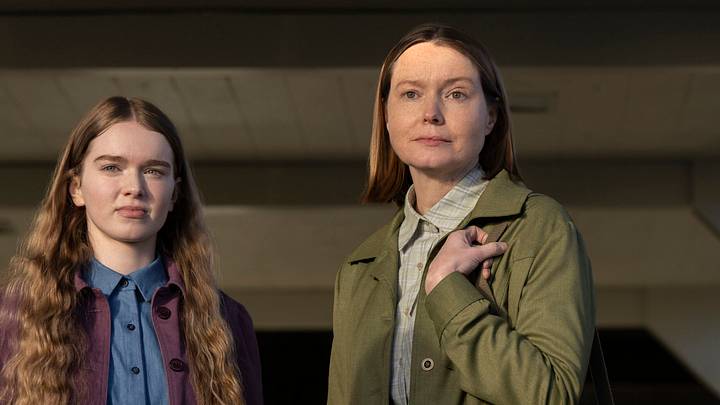
The sixth episode of Mike Flanagan’s new Carrie TV series on Prime Video, titled “Home Economics,” is written by Rebecca Klingel and directed by Hiromi Kamata. And folks, after several installments that were only ‘pretty good’ with a few ebbs-and-flows in quality, this sixth episode sees all of the chickens coming home to roost and Carrie well and truly culminating into something special. “Home Economics” is far and away the best episode of the series thus far, having many of its various storylines converge in a way that feels intimate, massively emotionally-charged, and best of all, truly and deeply rooted in the story of Carrie as a character.
While I found there to be a lot of promise in the debut of the series and a lot of the core ideas being floated about how to recontextualize Stephen King’s iconic novel both as an eight-episode series and for modern audiences, I certainly found there to be some growing pains in the process of that adaptation in subsequent episodes. Adding new elements — such as a Mean Girls-esque thread in which Chris Hargensen (as played by Alison Thornton) starts an anonymous Instagram account called ‘CarrieRed,’ through which she posts bullying memes about fellow classmates and teachers alike — made for interesting additions that helped to foreground the prescient themes at play within Flanagan’s restructuring, but I also became worried that they were pulling focus away from Carrie as a central character.
Summer H. Howell’s performance throughout this entire series has been so strong and such a great take on Carrie that it made these beats that kind of pushed her to the sidelines a bit all the more detrimental to the show as a whole. But fortunately, “Home Economics” recentralizes things and very explicitly makes the entire ‘CarrieRed’ debacle about Carrie and Chris as characters. There’s certainly some hand-waving to get there, but I’m more than happy to let this slide because of just how wonderful it is to see this series get things so right here.

Carrie episode 6 review: "Home Economics"
“Home Economics” is pretty much my ideal version of what could possibly have come from a Mike Flanagan take on Carrie. It’s the kind of episode that is strong enough on its own that if the words “Stephen King,” “Mike Flanagan,” or “Carrie White” mean literally anything to you, then it is absolutely must-see TV. The bulk of the episode is about Ewen High School’s leadership setting up a mediation session between the Whites and the Hargensens, in an effort to find a middle-ground in which Chris can return to school prior to prom and gradutation. All of this is complicated by the fact that each member of the Hargensen clan (Michael Trucco and Heather Graham play the fractured father and mother respectively here, and are both packing such heat, it’s insane) and Margaret White herself (the untouchable Samantha Sloyan) all enter the mediation with their own distinct motivations and goals in mind.
Margaret White has gone from reclusive, uber-religious stay-at-home mother to a tradwife conservative influencer advocating for parental rights (all of which is somehow both deeply funny and deeply unsettling in terms of how pinpoint accurate it feels to modern culture) who has amassed a huge following on social media, and thus sees this mediation not just as a simple conflict between her daughter and a bully, but rather a performance on a global stage. These theoretical stakes are made explicit and physical through the presence of an ever-ballooning mob of students, teachers, and news crews outside throughout the mediation. This rules in numerous ways: first off, it makes the stakes of what is essentially a conversation between some folks locked in a room feel absolutely massive. But secondly and perhaps even more importantly, it opens the door for Carrie and Margaret to come into explicit conflict over Carrie’s own importance within this story, both from an in-narrative perspective and a metatextual perspective.
The way in which all of this is set up to beautifully build upon the foundations established in previous episodes, making it feel like all of these various paths are beginning to culminate in such impactful fashion here, is absolutely fantastic writing on Rebecca Klingel’s part. The gradual escalation over the course of the episode, the rising tension, and the way in which each character within the mediation room is given space to experience their own respective arcs over the course of this episode is absolutely masterful stuff.
I also have to talk about Hiromi Kamata’s direction, which is the best of the series thus far. The stark visual language that Kamata utilizes inside the mediation room being contrasted by the fluid camera movements and kinetic energy of the mobs outside is phenomenal stuff. Taking this distinct visual approach builds a cinematic scaffolding for the mediation-based performers to climb even higher, imbuing their every move with that much more explosive results through some great associative editing choices. This, of course, works that much better because literally everyone in the mediation room is giving their best performance of the season; it’s an all-star showcase full of unforgettable interpersonal moments.
The whole sequence builds to an increasingly intimate and invasive point, with everything else falling away (in a narrative, thematic, and especially visual sense) and boiling down to Carrie and Chris, and two words that need to be said, and it is incredible filmmaking from every angle. This is precisely what I think of when I think of Mike Flanagan at his best, and it’s a delight to see it so immaculately brought to visceral life here.
The needle drops are toned down here and the ones that are utilized work really well; the Newton Brothers’ fantastic score gets a bit more time to really shine, and the sound design is tangibly entrancing stuff. And then, to top it all off, Klingel and Kamata give us a handful of phenomenal epitaphs to close out the episode. The first is an unexpected but beautifully executed narrative swerve centered on Sue Snell and Tommy Ross, with performers Siena Agudong and Joel Oulette doing miraculous work together. And the last is a confrontation between Carrie and her mother that is so immensely satisfying and one of my very favorite scenes of the series thus far. A blood-pumping, hair-raising moment that makes you want to play the next episode as fast as humanly possible.
Verdict
“Home Economics” is a home run of an episode. Even the narratively unrelated cold open is the best one the series has ever done, tying into the story at hand in such fascinating thematic ways. This episode is Carrie deliberately carving through the fat and gristle and leaving only lean, mean, juicy meat on the bone, and it rules. A phenomenal episode of television that has me incredibly hopeful for the final two episodes.
GRADE: A
 Add us as a preferred source on Google