

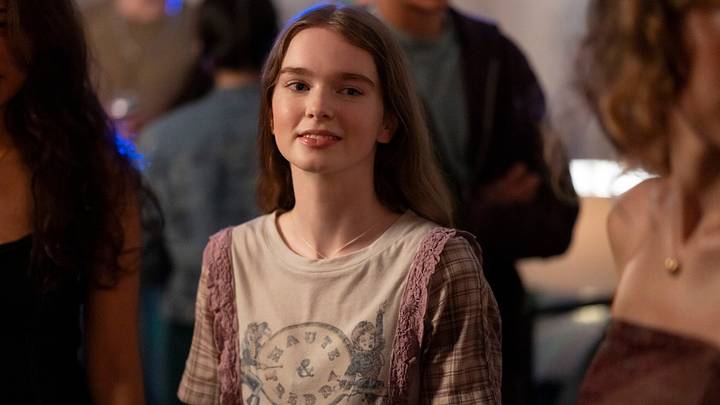
The third episode of the new Carrie TV series titled “Social Studies” is written by Justina Ireland and directed by Kate Siegel. Notably, this is the first episode of the series to not be directed by showrunner Mike Flanagan, as Siegel (who is an obscenely talented actress, director, and Flanagan’s longtime collaborator/wife) steps in to helm this third episode. Where I found the second episode of the series, “Foreign Language,” to reveal some of the growing pains that the adaptation process had wrought amidst its high points, “Social Studies” does an admirable job of homing back in on the central story at play here.
The bulk of the story of this episode revolves around Carrie being unexpectedly invited to a high school party and attending. This is notable in that it is the first episode in the series to feature almost entirely new material. Stephen King’s iconic Carrie novel is a relatively short read (it’s actually one of King’s shortest novels ever), so expanding it to fill an eight-episode season of television was always going to involve some taking of creative liberties. This much was readily apparent from the start, but where some of the material “Foreign Language” added to the narrative left me dubious of its overall role within the story, the excursions in “Social Studies" are much more palpably rooted in the story of Carrie White as a character, playing in much more interesting and ultimately satisfying ways.
Does Stephen King’s Carrie or Brian De Palma’s initial 1976 film adaptation feature a sequence in which Carrie White (as played here by Summer H. Howell) goes to her first high school party at the behest of Chris Hargensen (Alison Thornton) and Sue Snell (Siena Agudong)? No, but the ways in which Ireland and Siegel utilize this idea to further develop and dig into Carrie’s arc within the context of this televised medium is fascinating.

Carrie episode 3 review: "Social Studies"
The curvature of Carrie’s arc in the original iterations of the story is simple and obscenely effective; she’s an unpopular girl who experiences trauma on all fronts, finds happiness in the form of someone forging a genuine human connection with her at prom, only for that to be ripped away from her. Oh, and also she has telekinesis, which she utilizes to exact gruesome revenge on that fateful prom night. But here, dealing with a much greater amount of runway, Flanagan and co. have already demonstrated a penchant for recontextualizing key moments from that original story and adding entire layers of depth and nuance to the proceedings. Is this for the purposes of meeting the episode count? Maybe, but it also does give these creatives the chance to explore different facets of this classic story and characters (many of whom are so ingrained in pop culture at this point that they’ve become archetypes unto themselves) in new and compelling ways.
One of the best examples of this consistently throughout the series has been the relationship between Carrie and her mother Margaret (as played incredibly by Samantha Sloyan) and that very much continues to be the case here in “Social Studies.” The ways in which this mother-daughter dynamic and the conflicts between them have been brought into a much more human and empathetic space within these first few episodes feels like Flanagan’s whole approach at its very best.
Another example of the positive ways in which these changes can work, for me, is the entire party sequence. Getting to see Carrie experiencing genuine joy here, losing her inhibitions, is genuinely striking. Between Ireland’s adept writing, Siegel’s articulate and profoundly empathetic visual work, and Howell’s mesmerizing performance, this whole idea really soars in execution. Howell plays the whole sequence like audiences are watching a flower bloom before our very eyes, seeing who Carrie truly is beneath all of the trappings and expectations placed upon her by her mother, her teachers, and her fellow students. It’s a tender series of moments for her as a character that the entire creative team sells with aplomb. Of course, this is also a show that literally starts by telling audiences things are going to end in destruction come prom night for Carrie White, so there is an inherent element of tragedy to all of this as well.

Having said all of that, there are also developments here that I was not such a huge fan of. For one, three episodes in, it has become increasingly apparent that Carrie is stylizing many elements of its form and content to appeal to younger Amazon Prime-friendly audiences. There’s absolutely merit in this at times; the idea that Ireland and Siegel are exploring feminine adolescence with such a poetic eye here, as in scenes like Carrie’s stargazing or subsequent ride home with Tommy (as played to idyllic perfection thus far by Joel Oulette) is awesome, and its great that scenes like this are likely playing to millions of viewers directly in that age range right now. However, some of the editing choices and, even more specifically, the musical choices are distracting from the work as a whole.
In years past, Flangan projects have often had killer musical scores provided by The Newton Brothers. And in Carrie, that remains true; when the Newtons are given the chance to provide musical motifs and themes, they really soar. An early scene of Carrie reading about witchcraft in the library features some of their best work of the season thus far, finding a real sense of synchrony. But so much of Carrie is scored by needle drops that it can become intrusive. Even this episode’s narration-heavy cold-open documentary bit (something which has become a feature of each episode) isn’t scored by the Newton Brothers, but rather by a very wordy pop song playing underneath of it. It’s a strange choice that I imagine has been made time and again to help emphasize the modernity of this iteration, but it comes at a cost.
Similarly, “Social Studies” is now the second episode of Carrie in a row to feature a climactic beat in which the camera dramatically pushes in on Chris Hargensen posting something on Instagram, accompanied by a painfully on-the-nose needle drop of a song whose lyrics detail the very actions she is taking. Again, there is absolutely merit in exploring the modern anxieties and trappings of teenagerdom in 2026 through this show, but the recycling of this exact same beat again just emphasizes how thin certain elements of the long-form plotting can feel.
I will also say that I continue to remain confused by the presence of what continue to appear to be other telekinetically-gifted characters. I’m just kind of running with the assumption that this will amount to something beneficial in the long term; I feel like Flanagan and co. have earned that level of trust, at least. But the continued hints about how their roles could ultimately affect the ending of this story do leave me increasingly concerned that the pitch-perfect ending of King’s story could see some major adjustments.
Verdict
Overall, “Social Studies” is a step up from the previous episode, featuring some really strong character work and fantastic filmic work. However, for as strong as some of the adaptational changes are, there are other elements that seem to hamper the work as a whole and leave me a bit befuddled as to their inclusion or prioritization.
GRADE: B-
 Add us as a preferred source on Google