

Spoilers ahead for The Rings of Power season 3, episode 6.
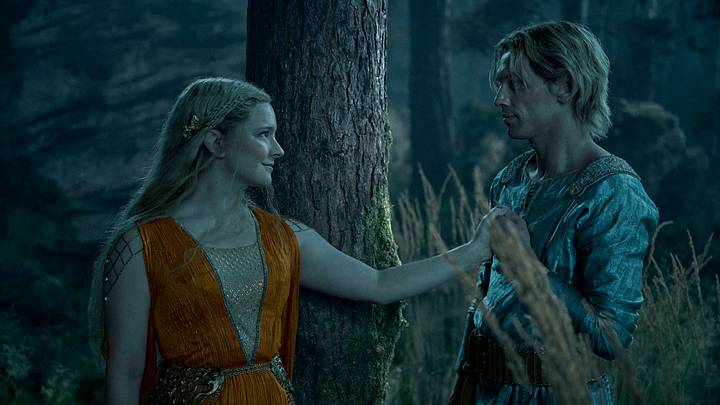
Prime Video’s The Lord of the Rings: The Rings of Power showrunners said there was a love triangle between Galadriel, Sauron, and Celeborn in season 3, and they may just be right. Everyone is free to interpret the show however they wish, as the cast and crew’s contradictory sprawl of comments over the years proves. But the Sauron-Galadriel romance tease faced backlash from the start, so why double down on it in season 3?
The core of the original
In The Lord of the Rings novels, Galadriel is radiant, wise, and untouchable. Tolkien said in The Letters of J.R.R. Tolkien that he owed “much of this character to Christian and Catholic teaching and imagination about Mary.” Accordingly, in Peter Jackson’s movies, Cate Blanchett’s Galadriel is a Virgin Mary figure, moonlit, sacred, and set apart from the business of war.
Elsewhere, she is more complex. Tolkien entrusted the editing of The Silmarillion to his son, Christopher, who published it after his father died in 1977. Across Unfinished Tales and The History of Middle-earth, Christopher revealed how he agonized over what made the cut, sharing the myriad versions his father wrote.

Romance and ruthlessness
Unfinished Tales contains a warrior Galadriel with a name (Nerwen) meaning “man-maiden.” Here, she was a pupil of the blacksmith Vala, Aulë, as was Sauron, and stayed in Middle-earth while Sauron remained a threat. This Galadriel met Sauron in Eregion and seemed to see through his disguise, but let him stay. The show addresses this question, plus that of why Galadriel perceives the Dark Lord’s mind while he gropes after hers in The Fellowship of the Ring.
In Unfinished Tales, the great Elf blacksmith Fëanor was obsessed with Galadriel. Sound like anyone you know in Rings of Power? While fidelity was key to Elvish marriage, “Laws and Customs among the Eldar” in Morgoth’s Ring details how Elves’ minds may wander if their spouse is lost. In The Rings of Power, Galadriel uncanonically thinks Celeborn gone and focuses on Sauron’s threat, not realizing how similar to him she becomes in her pursuit. Ruthlessness is a classic Noldorin weakness, as The Silmarillion’s kinslayings show.
Galadriel and Sauron are opposites who also share a surprising amount in common. From here, the romantasy tropes of enemies-to-lovers and lovers-to-enemies write themselves, even layered on top of animosity. Their oppositionality and similarity made them uniquely able to connect. This is the “cosmic connection” cast and crew referred to throughout season 1, before season 3’s less veiled romantasy tone.
In season 3 episode 6, Sauron disguises himself as Galadriel and pries not just the secret of ring-making from Celeborn’s lips, but a kiss. He says: “And I thought it was bliss when Galadriel submitted to my will.” As Sauron says, his highest pleasure is domination. But it’s unclear which act of domination takes him to new heights—the secret, the kiss, or both. Where season 1 took a character with no ascribed sexual relationships and gave him optional heterosexual subtext, this scene offers optional bisexual subtext in a definitely ruthless assault. Season 3 cranks up the romantasy subtext until it’s almost text, but it never quite becomes text.

One Ring to bring them all, and in the darkness bind them
Showrunners J.D. Payne and Patrick McMay pitched a five-season show covering the five-minute LotR prologue. They got their wish, but as discussed with Signum University, Amazon wanted this to be its Game of Thrones, an epic, cinematic watercooler fantasy. This expects a contemporary take on romance that captures a wide audience. Romantasy has gone mainstream, one of the fastest-growing genres of the last five years, so it’s easy to see why the show riffed off it, and almost hard to see how it could meet its criteria without an element of it.
Tolkien’s work was groundbreaking, so innovating helps adaptations do it justice. The show puts a tried-and-tested spin on old material, so sometimes it seems more commercial than innovative. But the show shines when it leans into what it does best, some of which is romantasy. Seasons 1–3 could have been an unblemished Galadriel-Celeborn love story, but Peter Jackson already made a romance-centric medieval fantasy, so that fails the groundbreaking test at the word go. The "love triangle," for lack of a better word, isn't perfect, but it is nuanced, fleshing out motivations rather than retconning them. And, without it or something similar, there may be no Silmarillion adaptation.
Without Maia Melian and the Elf-king Thingol, there would be no Lúthien, who overthrew Sauron at Tol-in-Gaurhoth. Her union with the mortal Beren runs down to Elrond, Elros, and Arwen, the line Aragorn marries into. Aragorn and Arwen’s story repeats Beren and Lúthien’s: a union bridging two peoples with every reason for suspicion and war. It’s love or death in Tolkien’s world; marriage and its consummation are war’s remedy. Without good drama that resonates with a contemporary audience, the true themes of the source material, not least this one, just won’t come through.
The show’s flaws are its moments of misjudged compromise between faithfulness and good drama. Season 2 should have committed more to the genuine friendship between Sauron and Celebrimbor, instead of breaking its glamour with a faithfully abhorrent Sauron who ended up looking kind of childish. Season 3 is more consistent and less compromising, following the subtextual dynamics between Sauron, Galadriel, and Celeborn far further to their logical conclusions. The result is good drama, shocking and unorthodox while intriguingly defensible. The One Ring forging is an original, layered, Tolkienian scene that will probably be influential, and some of those layers couldn’t exist without the show’s romantasy elements.

Not all who wander from canon are lost
Tolkien loved to confuse perspective, which was surprisingly meta for 1954. The Lord of the Rings is actually a book started by Bilbo, written by Frodo, and finished by Sam. This undermines its reliability, and that of the legendarium’s many other texts, written by Elves, Men, Hobbits, and even Sauron’s forces. This layered perspective is a huge part of what makes the legendarium a mythopoeia: not a collection of stories, but a collection of myths.
It cracks the stories wide open to interpretation. That’s the legacy Tolkien left adapters. In a letter to Milton Waldman, he said he wanted his connected legends to “leave scope for other minds and hands, wielding paint and music and drama.” Tolkien wanted his myths to endure. As a specialist in historical texts, he wouldn’t have expected adaptations to look the same in 1954 and 2026. The Rings of Power does drift far from what Tolkien wrote, but it is not necessarily all too far off what he intended, and it’s more fun every season.
The Lord of the Rings: The Rings of Power season 3 is streaming now on Prime Video, with the final two episodes arriving on November 25. For more on Galadriel’s husband, see what Jamie Campbell Bower says about Celeborn’s past and our guide to the sprawling cast of characters in season 3.
 Add us as a preferred source on Google