

There's something about the holiday season that makes a great book feel even better—maybe it's the slower pace, the excuse to stay in with something warm, or just the fact that you finally have more than 20 minutes of uninterrupted reading time.
Whatever the reason, vacation is the perfect moment to give yourself over to a genuinely good novel, and science fiction has always been the genre that rewards full surrender. Today we have a list of 12 sci-fi reads that cover pretty much everything from time-traveling Victorian explorers to raccoon private investigators, from a lone astronaut piecing together why he's floating alone in space to a man who can see five seconds into the future and has absolutely no idea what to do about it.
Some of them will make you laugh so hard you'll disturb whoever is nearby. Some of them will perhaps ruin you in the best possible way. All of them are worth a place on your holiday reading list.
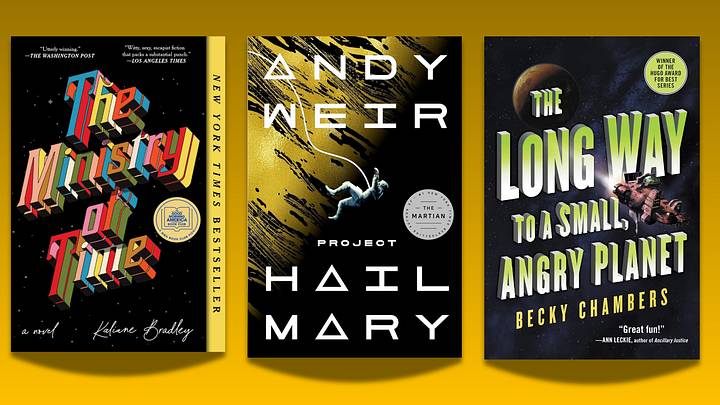
The Ministry of Time by Kaliane Bradley

If you are looking for a sci-fi that casually refuses to fit in any single box, this one might just be your holiday discovery. The Ministry of Time is a time travel romance, a spy thriller, a workplace comedy, and an ingenious exploration of the nature of power and what love might do to it, and somehow Bradley makes all of that feel completely natural.
The premise is delicious: a secretive Whitehall ministry is working on time travel, pulling various people out of their own eras and dropping them, slightly bewildered, into the present. Our unnamed narrator is assigned as a "bridge" to one of these extracted people, a Victorian naval officer named Graham Gore who survived the doomed Franklin expedition, and what follows is part cultural collision comedy, part slow-burn romance, part shadowy government conspiracy.
What makes this novel sing is the way Bradley uses its fish-out-of-water story to explore cultural identity and the legacy of British imperialism, threading serious ideas through scenes that are frequently very funny. Graham Gore adjusting to the twenty-first century, with all its baffling freedoms and conveniences, is so endearing.
With razor-sharp wit, workplace banter and a dreamy romance all wrapped up in time travel shenanigans, The Ministry of Time is a wildly fun read, and Bradley has a gift for making you care deeply about characters before you've even quite realized it's happened.
Service Model by Adrian Tchaikovsky

Next on our list is something a little darker and considerably funnier than you'd expect. In Service Model, Humanity is a dying breed, utterly reliant on artificial labor and service, and our protagonist Charles is a household robot who, through a series of events he is not entirely certain about, finds himself without a human to serve.
So he sets out across a crumbling world to find a new purpose, and what follows is a novel that reads like a riff on a whole collection of classical authors, with chapter headings nodding to Christie, Kafka, Orwell, Borges, and Dante. That should give you some sense of the ambition on display.
Tchaikovsky has always managed to smuggle extremely serious ideas into thoroughly entertaining packages, and Service Model is a good example of exactly that. The novel works with one of the major pitfalls of humans designing artificially intelligent systems, playing with the tension between our nuanced world and the binary logic of a machine trying to navigate it, with results that are both comical and disastrous.
The Man Who Saw Seconds by Alexander Boldizar

Here is one you may or may not have heard of yet, and we need to put it on your radar. Winner of the 2025 Locus Award for science fiction novel, this is a gripping speculative fiction thriller blending absurdist satire and adrenaline-charged suspense, and the central concept is so elegantly simple that you'll be amazed it took this long for someone to do it properly.
Preble Jefferson can see five seconds into the future, which sounds like a superpower until you realize it immediately makes him a target for every intelligence agency and military operation on earth, because a man who can dodge bullets and predict actions five seconds ahead is simultaneously the most valuable and most dangerous individual alive.
The novel is a tightly-wound but thoughtful thriller that thoroughly explores the central idea, examining the many ways this ability affects the character and his relationship to the world. The action sequences are extraordinary, the satire cuts deep, and the whole thing has been compared to everything from Joseph Heller to Stephen King, which is quite a range and probably apt for just how hard this book is to pin down.
When the Moon Hits Your Eye by John Scalzi

John Scalzi is known for making the absurd feel like the most natural thing in the world, and this novel is perhaps his purest expression of that gift so far. The premise is almost unbelievable: the moon has turned into cheese, and now humanity has to deal with it!
Scalzi uses that premise to examine how people, institutions, capitalism, grief and hope all respond to the impossible and the unprecedented.
The novel is a series of vignettes starring a large ensemble cast, including an ex-professor of philosophy, a tech billionaire, several astronauts, a sex worker turned real estate agent, and many others all coping with the same ridiculous reality in different ways. It's very funny and very quietly worried, and totally deserves a palace on your holiday reading list.

Green City Wars by Adrian Tchaikovsky
This is another spectacular entry from Tchaikovsky is one that came out this year. The future is green in this novel: humanity's old cities have been replaced by eco, biodiverse cities where humans and nature thrive hand in hand.
The twist is that this sustainable future doesn't use robots for its service needs, as Service Model imagined. Instead, it uses genetically engineered animals of all species to perform the menial work. And our protagonist navigating all of this is Skotch, a raccoon private investigator who is hired to find a missing mouse in a city full of class tensions, corporate intrigue, and creatures who are navigating their own complicated relationship with the humans who made them.
One can say it is solarpunk and hard-boiled detective fiction modeled into one. Perfect for fans of both Redwall and Raymond Chandler, somehow.
Starter Villain by John Scalzi

If you are looking for a book to give to someone who thinks they don't like science fiction, hand them this one. Starter Villain follows Charlie Fitzer, a substitute teacher who unexpectedly inherits a hidden supervillain empire from his mysterious uncle, and from that premise Scalzi proceeds to have an enormous amount of fun while also making pointed observations about capitalism, class warfare, and what it really means to profit from human suffering.
The cats who work as intelligence operatives and have strong opinions about labor negotiations deserve their own paragraph but we will resist.
The novel won the 2024 Dragon Award and was a finalist for the 2024 Hugo Award for Best Novel, and once you pick it up, you'll know very quickly why it gets the love it gets.
This is Scalzi doing what he does best: taking a bonkers concept completely seriously, filling it with genuinely funny dialogue, and sneaking real satirical observation in through the side door. It is funny, very sharp and it moves fast enough that you will finish it in a day and immediately want to start it again.

The Left Hand of Darkness by Ursula K. Le Guin
Stepping back now into the classics, and this is the one that could be argued to have changed what science fiction could be. Published in 1969, The Left Hand of Darkness earned Le Guin the Nebula Award and the Hugo Award, and helped establish her as one of the most important voices in science fiction.
The story is set on Gethen, a cold planet whose inhabitants are biologically neither male nor female for most of their lives, only briefly cycling into one sex for reproduction, and Le Guin originally called it a thought experiment, saying she “eliminated gender to find out what was left.” What she found was politics, loyalty, betrayal, climate, the nature of power, and the possibility and limits of understanding between people from radically different worlds.
The novel follows a human envoy, Genly Ai, sent to persuade Gethen to join an interplanetary federation, and his growing relationship with a Gethenian politician named Estraven forms the quiet emotional core of the whole thing. It is a seminal sci-fi work in which the science is more often sociology and biology than physics, a gender-bending meditation on the possibility of understanding between different cultures and the limitations of friendship.
It is not a fast read in the way that some of these other books on our list are, but what you get in return is something that will change how you think about identity and difference and what we owe each other across vast gulfs of experience. Few books do that at this level, and fewer still have held up this well across five and a half decades.
The Hitchhiker's Guide to the Galaxy by Douglas Adams

Somewhere on the unfashionable end of the Western Spiral Arm of the Galaxy, Douglas Adams published this book in 1979 and nothing in comedic writing has quite been the same since. The story is both very simple and spectacularly not: Arthur Dent, a totally normal English guy, wakes up to find that Earth is about to be demolished to make way for an intergalactic bypass, and before he can process this, he is whisked away into space by his friend Ford Prefect, who turns out to have been a researcher for the eponymous guide this whole time.
What follows is an adventure across the galaxy that doubles as an extended meditation on how completely indifferent the universe is to any of us, delivered with enormous warmth and extremely precise wit.
In 1978, when Adams unleashed Hitchhiker's on the world as a late-night radio series, the idea of a knowing, very English and comedic take on science fiction seemed utterly new and fresh, and in many ways it still does. It’s essential, essential reading, if you have somehow not read it yet.

The Long Way to a Small, Angry Planet by Becky Chambers
Becky Chambers's debut novel is about a crew of wormhole builders traveling across space to punch a tunnel near a distant, hostile planet, and while that sounds like the setup for a thriller, it is really the setup for a long, gorgeous slice of life about found family and chosen belonging.
The Long Way chooses to focus on the little people, specifically a multi-species found family whose main concern is completing their next job, and there is something deeply refreshing about that in a genre that often defaults to galaxy-shaking stakes.
Chambers has a gift for making you fall in love with characters through small, specific, entirely human (and not-human) details, and by the time you reach the emotional ending, you will be astonished at how much you care about people you only met a few hundred pages ago.
I would say reading a Becky Chambers book is a different experience from any other author. Every time you feel the anxiety of anticipating conflict, the situation is diffused, lessons are learned, and Chambers once again imparts wisdom on how to be a grounded, fulfilled person. It is sci-fi pre-school, as has often been teased, but honestly, sci-fi pre-school run by Becky Chambers sounds like a wonderful place to spend a holiday.
The Galaxy, and the Ground Within by Becky Chambers

One more spectacular Becky Chambers and this one holds a particular quiet magic. It is the fourth and final book in her Wayfarers series, though you can read it completely on its own, and its setup is almost ostentatiously simple.
With no water, no air, and no native life, the planet Gora is unremarkable: it exists only as a waystation, a rest stop for travelers in between wherever they're going. When a sudden crisis traps several very different beings on the planet and prevents anyone from leaving, they have nothing to do but wait together and talk.
It is also a gorgeous farewell to a series that has meant a great deal to a great many readers. If you have not read any Chambers yet, start with The Long Way. If you have, come here and let her wrap up this universe with the gentleness and care it deserves.
Flowers for Algernon by Daniel Keyes

This is one of those novels that earns the word "essential" in the truest sense. The premise is as elegant as it is devastating: a man gains a genius-level IQ through experimental surgery.
The whole story is told through Charlie Gordon's journal entries, and watching his writing transform as his intelligence rises and then, inevitably, begins to fall is one of the most technically extraordinary things you will encounter in twentieth-century fiction. Keyes had to write the same character's voice at approximately fifteen different cognitive levels while maintaining emotional continuity throughout, and he pulls it off with devastating skill.
The short story version won the Hugo Award for Best Short Fiction in 1960, and the novel was joint winner of the Nebula Award for Best Novel in 1966, and both of those recognitions feel appropriate and also somehow insufficient.
Flowers for Algernon asks questions about intelligence and what we equate it with, about how we treat people we consider less capable, and about whether wisdom and intellect are the same thing at all. Keep tissues nearby, and do not read this one in public unless you are comfortable with strangers watching you try to hold yourself together.

Project Hail Mary by Andy Weir
We saved this one for last because this is the kind of book that reminds you exactly why you fell in love with the genre in the first place, the one you press into people's hands and watch their faces change over the following week.
The setup if you haven't watched the 2026 blockbuster: the sun is being eaten by an alien infestation, mankind will cease to exist in 50 years, and so there is a "Project Hail Mary." Our protagonist, Ryland Grace, wakes up alone on a spaceship with no memory of who he is or how he got there, and the first third of the novel is him piecing together what his mission is and what it means.
It is a masterclass in doling out information, and the moment things click into place is one of the most satisfying experiences you will have as a reader this holiday.
Nobody writes optimistic science adventure as well as Andy Weir, and Project Hail Mary is every bit as entertaining, inspiring, and satisfying as his The Martian. The science is real and exciting and explained in a way that makes you feel warmly clever for following along.
But what elevates this beyond clever puzzle-solving is the relationship that develops roughly a third of the way through the story, which we will not spoil here except to say that it is one of the most surprising and moving friendships in recent science fiction, and it is the reason people finish this book and immediately want to tell everyone they know about it.
It is smart without being overwhelming, exciting without sacrificing character development, and emotional without becoming overly sentimental. It is, to put it plainly, something close to perfect.
Have a wonderful holiday season!
 Add us as a preferred source on Google