

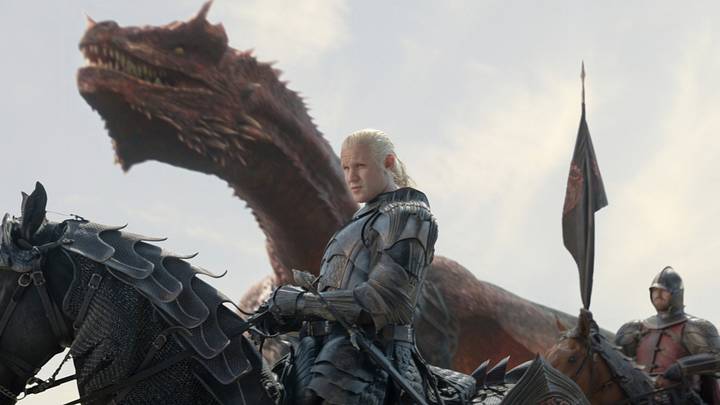
More often than not, dragons in fantasy are portrayed as fearsome monsters or magnificent creatures that the heroes must overcome. But in A Song of Ice and Fire, the role of dragons is much more complex. They are weapons of mass destruction, but also symbols of political legitimacy. They are an extension of their riders, and a living reminder of a lost civilization.
The return of the dragons through Daenerys Targaryen's three eggs, which happened nearly 150 years after the last known dragon died, sets one of the main stories of A Song of Ice and Fire/Game of Thrones in motion.
Their sheer power makes the dragons in House of the Dragon especially important. Their bonds with their riders, their size and might, the process of claiming them, and the huge consequences of losing one played as much of a part in the Dance of the Dragons as any political alliance or battlefield victory.
Here are the 10 most significant dragons in the show, ranked by their history, influence, and impact both before and during the Dance.
10. Seasmoke

Seasmoke might not be the largest or most historically significant dragon in the Targaryen dynasty, but he has already shown why even a relatively young dragon can be a pretty big asset in battle.
His first major appearance in season 1 takes place during the War for the Stepstones, when Laenor Velaryon rides him into combat against the Triarchy. The sequence had one of the show's earliest glimpses of dragons being used as weapons of war. Seasmoke's sudden arrival helps turn the tide of the battle and saves Daemon Targaryen’s life.
His pale grey appearance, which can look almost silvery in certain lighting, gives him a distinctive look without the imposing size of older dragons.
9. Tessarion

Known as the Blue Queen, Daeron Targaryen's dragon, Tessarion, stands out with her striking cobalt-blue scales, which make her one of the most visually distinctive dragons in the Targaryen collection.
She is also younger than the other, larger veterans of this conflict, but that doesn't stop her from becoming an important part of the Greens’ military strategy. Unfortunately, season 3 did skip over some of her bigger contributions to the Dance, such as not participating in the First Battle of Tumbleton, unlike in the books. But season 4 should make up for it, and she’ll have much more to do.
8. Dreamfyre
Dreamfyre is an example of how a dragon's historical importance can exceed its role in the present conflict. Although she hasn't participated in the Dance as extensively as some of her counterparts, her history goes back several decades before the events of House of the Dragon.
She was originally claimed by Princess Rhaena Targaryen and became one of the most prolific egg-laying dragons. Her current rider is Helaena Targaryen, whose unusual relationship with Dreamfyre has remained largely unexplored on screen.
George R.R. Martin has hinted that the three dragon eggs stolen from Dragonstone may have been laid by Dreamfyre, which eventually ended up with Daenerys. This still remains just a theory, but just the possibility of it gives Dreamfyre an important place in the franchise's larger mythology.
7. Sheepstealer

Unlike the carefully maintained dragons of the Dragonpit, Sheepstealer spent much of his life as a wild creature.
The show's design makes him particularly unique. His rough and almost deformed appearance separates him from the more conventionally majestic dragons, with uneven features and a sharp body that really show a creature shaped by years of surviving in the wilderness.
Rhaena Targaryen eventually manages to claim him, which gives the Blacks another dragon after their forces have suffered several devastating losses with the deaths of Rhaenys and Jace (the latter of whom he played a part in), and the betrayal of Ulf.
6. Meleys
Meleys, better known as the Red Queen, was one of the most formidable dragons in Westeros before the Dance even began. Her speed and bright red scales made her instantly recognizable.
In season 2, Rhaenys and her dragon were sent to Rook’s Rest to confront the Green forces, and Meleys initially made short work of Criston Cole's army before Aegon and Aemond joined the battle with Sunfyre and Vhagar.
Even against two dragons, Meleys proved capable of fighting back. She seriously injured Sunfyre before Vhagar ultimately killed her. Her death was a major setback for the Blacks. Rhaenyra lost one of her most experienced dragonriders, which led her to seek out more of them as part of the Sowing.
5. Sunfyre

Few dragons in Westeros are as closely associated with their rider as Sunfyre the Golden is with Aegon II. Often described as the most beautiful dragon, his golden scales do justice to his name.
Sunfyre is among the smaller dragons in the Dance, but his appearance and close bond with Aegon make him one of the most memorable. Not to mention what else he has in store for the upcoming final season of the show.
This strong bond is also one of Aegon's few genuinely sympathetic and redeeming qualities. The former king is hardly a model of virtue, but his affection for Sunfyre feels sincere, especially when compared with all the political stuff surrounding almost every other relationship in his life.
Their reunion in season 3 was one of the best moments of that season. With news of them both still being alive spreading across Westeros, the two are once again a serious threat to Rhaenyra's claim.
4. Silverwing
Silverwing has one of the most remarkable histories of any dragon still alive during the Dance. She hatched during the reign of Jaehaerys I and was originally claimed by Queen Alysanne Targaryen. Alysanne and Silverwing were inseparable for decades, and the dragon even accompanied the queen on journeys beyond the traditional boundaries of the Targaryen kingdom, like to the Wall.
Although, her current rider (Ulf White) is a much less distinguished successor. His betrayal is one of the most consequential elements of season 3.
It also makes Silverwing’s future role in the war troubling. A dragon once associated with one of the realm's most beloved queens has now become a weapon in the hands of an increasingly unreliable rider, and one that doesn’t live up to the dragon’s stature.
3. Vermithor
Vermithor is one of the most intimidating dragons still alive, and his enormous size is matched by a history that goes all the way back to the height of the dynasty's power. He is known as the Bronze Fury, due to his bronze-colored scales and impressive horns, which give him an imposing appearance that reflects his reputation.
This dragon also has a notable military history before the Dance. During the Fourth Dornish War in 83 AC, King Jaehaerys rode him into battle alongside his sons Aemon and Baelon, who rode Caraxes and Vhagar, respectively.
Vermithor and Silverwing were practically inseparable during the reign of Jaehaerys and Alysanne, and they flew together frequently. There's also a nice little parallel after these two were claimed by Hugh and Ulf, since the two dragonseeds also became allies and their dragons once again rode together.
2. Caraxes

Caraxes is arguably the dragon most perfectly suited to his rider. Daemon Targaryen is volatile and aggressive, and his dragon shares much of that personality. Known as the Blood Wyrm, Caraxes has an unusually long neck and a fearsome appearance that separates him from the more traditionally proportioned dragons.
Before Daemon claimed him, Caraxes was ridden by his uncle, Prince Aemon Targaryen. But it is Daemon who made him such an important figure in the Dance. Caraxes has already played a major role in the conflict and has participated in the most amount of on-screen combat so far.
1. Vhagar

Vhagar is easily the most important dragon in the Dance of the Dragons. Her presence has fundamentally changed the balance of power between the Greens and the Blacks. She is one of the oldest and largest dragons alive, and her absolutely enormous size makes her terrifying even before she enters a battle.
Vhagar’s legacy dates all the way back to Aegon’s Conquest as the dragon of Visenya Targaryen. She later passed through several riders, including Prince Baelon and Laena Velaryon, before Aemond Targaryen claimed her.
The Greens' greatest advantage had largely come down to just having Vhagar on their side, since the Blacks had the upper hand when it came down to the sheer number of dragons at each side’s disposal. But even multiple dragons might not be enough for one Vhagar.
Her size and battle experience have forced Rhaenyra's council to factor in her presence in pretty much every major strategic decision, including when to take over King’s Landing.
The first three seasons of House of the Dragon are streaming on HBO Max. The show's fourth and final season is currently in preproduction, and is slated for a 2028 release window.
 Add us as a preferred source on Google