

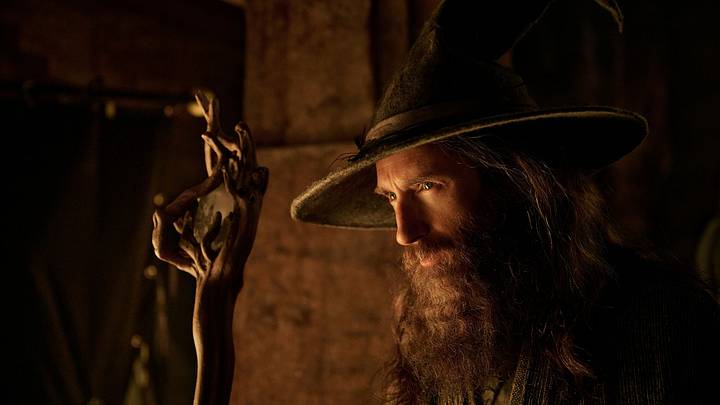
We're three episodes into The Lord of the Rings: The Rings of Power season 3, and the show still feels in many ways like it's just getting started. In "The Secret Fire," the scope expands yet again, this time to Rhûn, where Gandalf (Daniel Weyman) is hard at work trying to undermine the Dark Wizard (Ciarán Hinds). We also see a different side of Númenor, shifting away from the politics of the capital to the Havens in the west, where Elendil (Lloyd Owen) and his son Anárion (Andrew Richardson) are busy preparing to take the fight to Ar-Pharazôn (Trystan Gravelle). And in the north, Galadriel (Morfydd Clark), Arondir (Ismael Cruz Córdova), and the Orc Marnûkh (Adam Young) set out on a quest that bears a striking resemblance to a key part of the original Lord of the Rings trilogy.
"The Secret Fire" is a busy episode, but it doesn't suffer from how many balls it's trying to juggle. Its over-reliance on nostalgia bait, on the other hand, detracts from an otherwise solid hour of television, making this arguably the weak point of The Rings of Power season 3's four-episode premiere.
Full spoilers for The Rings of Power season 3 episode 3 beyond this point.

Wizards in Rhûn
Just as the cold open for "The Gift of Men" brought us to a new location, so too does the cold open for "The Secret Fire," which spends a solid 10 minutes immersing us in all the goings on at Rhûn. The Dark Wizard is attempting to revitalize the blasted landscape with his magic to no avail, but he believes a Ring of Power might just do the trick. This is why he sent his five subordinates to Mordor, in hopes of retrieving one of those Rings for himself.
That of course does not go to plan, as Khamul the Easterling (Zubin Varla) returns not as his servant, but as Sauron's Nazgnagôl. There's a standoff in the middle of the Dark Wizard's stronghold, but because he doesn't want to lose face in front of his acolytes, the two begrudgingly work together, with Khamul announcing his intention to gather all the peoples of Rhûn and march them to Mordor. There's an interesting thread running through these scenes, hinting at the mysterious past surrounding the Dark Wizard's former partner and how Rhûn became a desert, which comes full circle halfway through the episode. The foreshadowing that it's coming goes a long way to selling the ultimate reveal.
Unbenownst to the Dark Wizard and the Nazgnagôl, a pair of powerful beings are right under their noses, watching the drama unfold: Gandalf, and his pal Tom Bombadil (Rory Kinnear), the closest thing MIddle-earth has to an embodiment of natural life. Gandalf is very concerned about how to stop the Dark Wizard; Tom, on the other hand, responds with characteristic flippancy. Life goes on, regardless of evil plans or plots.
The cold open ends with Gandalf facing down an oliphaunt, which charges him in a rage. The Wizard manages to free the beast of its enchantment, and sends it off to freedom. This scene really captures the spirit of Gandalf and Tolkien so well; I especially love Gandalf's cheerful greeting to the animal as it prepares to attack him.
I'll admit, I was kind of surprised to see Gandalf is still hanging out with Tom Bombadil after the five-year time jump. The Rings of Power does seemingly wrap that story up in this episode though, when the pair convene at Old Tom's house and the Wizard grows frustrated with his reluctance to get involved. Gandalf swats an apple out of Tom Bombadil's hand, and the old nature spirit decides that it's time for him to move on to the Withywindle, which is the forest where he encounters the hobbits during the Third Age.

Gandalf heads out to gather a rabbit for their supper, and Tom sings a song in his hut. There's a feeling of finality to this scene; I wouldn't be surprised if it's the last we see of Old Tom Bombadil in this series, or at the very least for the majority of it. While I've been a little torn about the inclusion of Tom Bombadil in general, this exit feels pitch perfect for him, from Gandalf's frustration to Bombadil's singing and good-natured parting.
As for Gandalf, his quest for dinner is interrupted by a vision, sent to him by none other than Eru Illúvator — that would be the Tolkien legendarium's version of God, who wields the Secret Fire as a force of creation. This vision reveals the backstory for the Wizards, and for the "Dark Wizard" in particular. At last, we have confirmation that he is Pallando, one of the two Blue Wizards, and that his murder of the other Blue Wizard is what caused Rhûn to turn into a wasteland in the first place.
The Wizards are meant to save Middle-earth, but not in the way Gandalf thinks, by defeating his enemies. The Secret Fire reassures him that in fact, he's meant to save Pallando. This tracks so well with Gandalf's overall tone as a character; he's never the one to fight the big battle and save the day, but to bolster the goodness of everyone around him so they can do their part.
When Gandalf races back to inform Tom Bombadil about his vision, he finds the hut abandoned. All that's left of Old Tom is his hat — which, yes, is now Gandalf's iconic hat. The shot of Gandalf standing in the doorframe as he dons that hat for the first time gave me chills. This is the exact type of nostalgic nod that I like from The Rings of Power; clear, but not so on the nose that it feels jarring. It's a great, full-circle note to leave Gandalf on for the episode.

The Faithful fall into a trap
Over in Númenor, we spend time on the far western side of the isle, where the Faithful have their safe havens and training grounds. We're introduced to Anárion, Isildur's younger brother who is serving as one of the leaders of the Faithful army, along with his father, Elendil. Anárion's first scene does a great job of giving us a sense of his attitude toward his men, and hints at his skill with a blade. Is it a little bit generic? Maybe. But the Sindarin commands are a nice touch, and Andrew Richardson's easy charisma goes a long way toward making this new character feel like he's always been a part of this world.
I also found it kind of hilarious that we finally see why Anárion's sword is balanced on his shoulder; it totally works in the show, but in the first press image released of the character, it sparked a lot of conversation about why it was seemingly just...sitting there. Turns out, it's because Anárion is just that confident.
Elendil relays the news to his son that they have a spy in their midst, who is scheduled to meet with Pharazôn's agents at a nearby ruin. Anárion can't believe it's true, and rightly so, because it isn't. It hits harder watching this scene, and hearing Elendil say how Eärien (Ema Horvath) has never steered them wrong, knowing that she's already dead and the trap set for them.
The Rings of Power doesn't keep us waiting to see how that trap plays out. Elendil (somewhat stupidly) insists on going to catch the spy with only Anárion at his side, and when he goes to confront the mysterious figure, finds out it's none other than Kemen (Leon Wadham). Elendil tries to reason with Pharazôn's son, but is ultimately swept off in a carriage. We do get to see Anárion's insane skill with a sword, however, and that feels like a payoff in and of itself.
The Númenor section of the episode isn't quite as strong as what came in episode 2, but it largely feels like it's there to lay the groundwork for another shift coming in episode 4, when we see what happens next for Elendil and Kemen. Good thing the episode's already out so we don't have to wait!

Sauron does a bit of delightfully evil detective work
Another narrative strand that gets a smaller but no less potent bit of focus this episode is Sauron. The Dark Lord's story mostly exists here in conjunction with Galadriel's journey, which we'll talk about momentarily. His main aim of episode 3 is to figure out where Marnûkh is leading the Elves and why, so that he can intercept them. His Nazgnagôl are in hot pursuit, but after their quarry eludes them, Sauron takes a different tack: interrogating a married couple of Elves who survived the fall of Eregion.
These Elves were in the same band of prisoners which Marunûkh oversaw — which also, Sauron comes to find, included the Elven smith Maitalle. This interrogation scene features another masterful performance from Charlie Vickers, as he shifts from disarmingly kind to horrifyingly evil when it becomes clear that he's poisoned the wife with venom from a fire-drake's gland. If she coughs, she explodes — unless Sauron gives her the antidote.
The Rings of Power could have opted for a more traditional poison here, but this choice to use fire-drake venom made for a much more interesting and fantastical scene. It's also just fun, in a deliciously nefarious sort of way. Sauron demands answers while the Elven wife tries not to cough, and eventually does hand over the antidote...except it's too tightly stoppered for the husband to open it. She coughs, they explode, and Sauron walks away satisfied with the information they gave in their desperation to stay alive.
Sauron now knows Marnûkh's destination: Gundabad. And while it's weeks away from Mordor, Sauron intends to get their much quicker by utilizing an iconic mount from The Lord of the Rings lore: a fell beast, which he demands his Orcs saddle. This will be the first time we see someone fly one in this show, and it's going to be epic!

An imitation of a fellowship
Now that we've covered the breadth of the episode, let's back things up and talk about the one of the other central storylines of "The Sacred Fire": Galadriel, Arondir, and Marnûkh's journey to Gundabad. And unfortunately, while there are plenty of good things about this grouping of characters and the individual moments they all receive, this sequence as a whole fell completely flat for me.
The main problem with the journey of this small fellowship is that it largely relies on extremely heavy-handed nostalgia. It copies large swaths of Sam, Frodo, and Gollum's journey toward Mordor in Peter Jackson's Lord of the Rings films almost beat-for-beat, from bits of blocking to dialogue and narrative choices. Oh, but it's not all the Gollum storyline; there's also a reference to a different Lord of the Rings moment, where the hobbits hide from the Nazgûl beneath a moss-covered log.
The Rings of Power has always nodded to Jackson's film series despite having no behind-the-scenes connection, and on the whole, that's often fine. But in instances like this, where we're talking about entire storylines copied wholecloth, it becomes extremely distracting. It also feels like a massive disservice to The Rings of Power characters as well. Marnûkh, Galadriel, and Arondir are all fascinating figures in their own right, and many of their specific lines and scenes are fantastic. But by using largely un-earned plot beats from the Jackson films, it draws focus away from all that, so that it becomes a game of mental comparison to a different, more original piece of filmmaking.
This extends right down to the finish of the episode, where Arondir mistrusts Marnûkh, Galadriel sends him away, and then he comes running back to their aid in the final moments before the credits roll while they're planning their infiltration of Gundabad. That's exactly what happens with Sam, Frodo, and Gollum in The Return of the King, except it has way more tension because Sam arrives too late to stop Shelob from paralyzing Frodo. Here, we get the same storyline solely to include a reference, without any of the narrative weight it deserved.
The Rings of Power could have had the same exact storyline with this trio on the road, but not copied the Lord of the Rings' journey so closely, and it probably would have been better for it. Unfortunately, just like the lure of the Rings themselves, the temptation to lean on Jackson's beloved films was too great, and the episode as a whole was diminished for it. Here's hoping that the fourth episode course corrects as the team heads into the Orc stronghold of Gundabad.

Verdict
While The Rings of Power season 3 has thus far had a very strong start out of the gate, "The Sacred Fire" marks its first real stumbles. Some storylines are wonderfully entertaining, such as Gandalf's adventures in Rhûn and Sauron's gradual uncovering of Marnûkh's past. Númenor serves largely as some very engaging set up. But with this show's version of a fellowship heading toward Gundabad, it strayed a bridge too far into the unoriginal, robbing what should have been one of its most memorable sequences of the chance to stand on its own merits. It's a shame The Rings of Power didn't trust more in its own storytelling than in nostalgia bait there, but I'm hopeful it's just a blip in an otherwise entertaining journey.
Episode grade: C+
 Add us as a preferred source on Google