

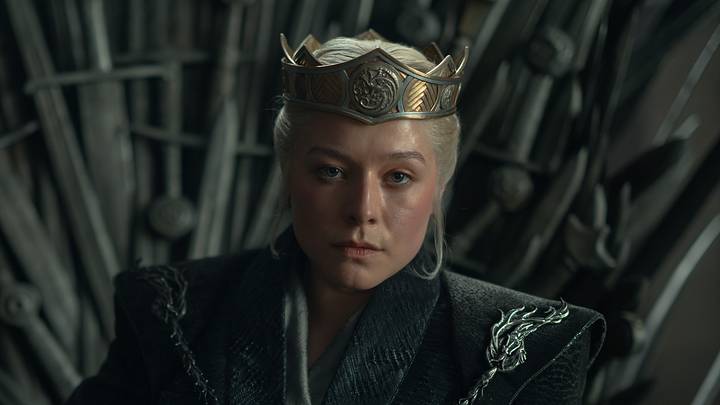
Despite being proclaimed her father’s rightful heir, Rhaenyra Targaryen (Emma D’Arcy) spends much of the first two seasons of House of the Dragon fighting to prove she deserved to rule Westeros. The third season, which aired this year, finally sees her sit on the Iron Throne, but at a hefty cost.
The second episode of the season sees Rhaenyra triumphant, with significant assistance from her husband-uncle Daemon Targaryen (Matt Smith). Yet, the victory is followed by ominous signs that it is the beginning of the end for her.
By the time she can call herself the Queen of the Seven Kingdoms, she has lost a daughter in birth and two sons to her enemies, and the losses haunt her every step in the Red Keep as the chaos of the regime change unfolds around her. Her grief is worsened by the inescapable burden of taking over a crumbling kingdom, and it gradually chips away at the compassion that once defined her.
By the finale, Rhaenyra has crossed several lines that would have been almost unthinkable earlier in the series. Yet her descent does not happen overnight. Season 3 repeatedly gives viewers glimpses of the queen she is becoming, and here are the most prominent ones.
1. Cutting her finger on the Iron Throne
In Westerosi lore, a monarch getting cut on the Iron Throne is a divine sign that the ruler is unfit to rule, and that their reign will be short and marked by tragedy.
It is believed Aegon I the Conqueror built the throne with swords so no one could rest easy on it or give in to intense emotions like fury or frustration without risking a quick nip from the blades.
Aegon himself bled by the throne in George R.R. Martin’s books, as were Maegor the Cruel and Aerys II, a.k.a. the Mad King. Viserys I (Paddy Considine) himself sliced his finger during an angry confrontation with his brother, Daemon, in the very first episode of House of the Dragon.
Now, years later, Rhaenyra suffers the same fate in season 3 episode 6, while listening to smallfolk complaining about supplies and resources.
The episode’s director, Loni Peristere, called it “one of the greatest scenes in the series,” one that points to the festering wound her reign has quickly become.
“There are infections that follow. There’s rot that follows,” he said in HBO’s Inside the Episode featurette. “It basically reveals what’s ultimately happening for real in Rhaenyra’s tenure as queen.”
“That cut on Rhaenyra’s finger becomes an instigating event for a lot of bad things,” Peristere added.
“There’s obviously some significant foreshadowing in this moment, though I don’t know to what extent Rhaenyra is cognizant of its significance,” added Emma D’Arcy.
2. Executing Otto Hightower
Wars kill thousands, and the one between the Blacks and the Greens had already taken many lives before Rhaenyra reclaimed King’s Landing, but she never killed anyone with her own hands.
Thus, one of the most important points in her turn towards darkness comes in season 3, when she swings the sword to execute Otto Hightower (Rhys Ifans) and steps over his blood to walk up to the throne.
It doesn’t come easily to her, and even with Dark Sister’s precision, she misses the first time and slices his neck. But the second strike separates Otto’s head from his body, and just like that, Rhaenyra’s hands become stained with the blood of someone she likely grew up seeing as a paternal figure.
We see fragments of Rhaenyra’s old self in her hesitation to kill Otto, and later when she looks bashful as Alicent Hightower (Olivia Cooke) walks into the throne room and sees her father’s dead body. But the deed is done, and from here on, we only see her grow increasingly comfortable dishing out cruelty without a second thought.
“The Rhaenyra character that we knew is now a very different person, from the point that Otto’s head rolls away from his body,” said showrunner Ryan Condal about the scene.
3. Changing her mind about Daeron and Red Keep staff
The season begins with Jacaerys Velaryon’s (Harry Collett) death in the Battle of the Gullet, and the tragedy becomes a driving force for Rhaenyra’s dark turn for the rest of the episodes.
In episode 3, as she walks down the corridors of the Red Keep with Mysaria (Sonoya Mizuno), Rhaenyra initially struggles with what to do about Daeron Targaryen, Alicent’s fourth child, whom Daemon had apparently captured earlier in the episode.
Despite Mysaria reminding her that Daeron is a living heir and thus a threat to Rhaenyra’s rule, she muses that he is young and has not personally done anything to deserve death, unlike his brothers, Aegon (Tom Glynn-Carney) and Aemond (Ewan Mitchell).
In that moment, she sees a hallucination of Jace walking toward her, which turns out to be just another Red Keep staff member. But her attitude changes immediately.
Rhaenyra begins to ponder if she should kill Daeron after all, just as her sons were killed, and orders Mysaria to identify Hightower loyalists among the household staff discreetly. In the moment, her decision seems like nothing but grief-fueled paranoia that can weaken her foothold even more with the common folks and her own employees.
Although Rhaenyra later chooses to send “Daeron” to the Night’s Watch, we learn that her worry was not entirely unfounded, as the boy turns out to be a decoy, with the real Daeron still under Ormund Hightower’s (James Norton) care.

4. Ignoring the smallfolk and other strategic miscalculations
Despite growing up in the palace as her father's heir, Rhaenyra has repeatedly shown a questionable understanding of politics and tactical decision-making, a creative choice many fans find unrealistic. Regardless, her shortcomings are on full display after taking King’s Landing.
Lost in grief and fear, she barely listens to the smallfolk's complaints, and when she does, she offers no real resolution. Eventually, she stops listening to public petitions altogether, creating further distance between her and the people she is supposed to rule.
After discovering the treasury is empty, she makes little attempt to secure more gold from her remaining allies. She focuses on faraway threats such as Ormund and Aemond, or on finding the rider of Sheepstealer, while neglecting her starving capital, drowning in its own atrocities.
She also orders the Gold Cloaks to deal with those responsible for the graffiti calling her the “Queen of Bastards.” Although those were very likely done by those paid off by Ormund, Rhaenyra responding with force and intimidation when the masses already lacked food and other resources does not paint a good picture of her.
It becomes clear that, at this rate, even without enemy intervention, Rhaenyra will not remain a favorite in the streets of King’s Landing for long.
While none of these follies are exclusive to Rhaenyra (Targaryens do famously go mad after all), her strategic failures pile up and damage her reputation more than some of her military missteps.
5. Alienation from her allies
Indeed, most of Rhaenyra Targaryen’s allies have never truly been on her side. We see them doubt her prowess as a monarch time and again, mostly because she is a woman, though it is not always made explicit.
Almost like a self-fulfilling prophecy, she proves them right when the time comes. Moreover, at a time when she could use allies more than ever, season 3 repeatedly shows her pushing them away, and she has plenty of reason to do so.
Mysaria keeps Helaena’s pregnancy from her after Rhaenyra entrusts her with rooting out Hightower loyalists, and she repeatedly tries to badmouth Daemon to secure her position. In the end, the queen sends her away before the Battle of Tumbleton.
Lady Sabitha Frey (Sarah Woodward) is angered when Rhaenyra uses Harrenhal as a bounty in the hunt for Aemond after promising the haunted castle to her earlier. Baela (Bethany Antonia) and Addam (Clinton Liberty) search for Vhagar and Aemond without rest, and Rhaenyra refuses to allow them a break.
While not truly an ally, Alicent, for all her blunders, keeps her word, but Rhaenyra does not honor their deal to let her and Helaena escape. Moreover, she sends Alicent to murder her son. However, she keeps coming back to Alicent for counsel, and she agrees to send her father’s body back to Oldtown upon her request.
Rhaenyra’s Hand, Corlys Velaryon (Steve Toussaint), grows frustrated with her refusal to immediately legitimize his sons, Alyn (Abubakar Salim) and Addam, even though he took his fair time doing so himself. He stops attending the Small Council meeting and goes after the Triarchy. When the Greens capture him, Rhaenyra refuses to prioritize his life.
When Baela confronts her, accusing her of using people close to her and discarding them when they are no longer useful, Rhaenyra reacts with cold fury, grabbing Baela’s face and calling her an “insolent child.”
It is a telling moment, since Baela is not a Green conspirator and has never shown any signs of disloyalty. More importantly, she is her stepdaughter and daughter-in-law, and she has also been grieving Jace.
6. Assassination and desertion of the Gold Cloaks
Not all of Rhaenyra’s steps toward her downfall after claiming the throne are entirely her own, but she certainly doesn’t help. One such is the slaughtering of the Gold Cloaks.
Sponsored by Ormund Hightower, assassins take out the City Watch guards one by one in the streets of King’s Landing. Daemon, once the group's commander and the one who gave them their iconic golden cloaks, brings it up with Rhaenyra during a Small Council meeting.
She pushes it aside, and Daemon argues with her in front of the other council members, then storms away to deal with the problem himself. His worries are proven right when, in episode 5, Hightower agents assassinate Ser Luthor Largent (Tom Cullen) and the upper echelon of the Gold Cloaks, leaving their corpses in a rather theatrical setting.
Between the lack of wages and the risk of being murdered, the rest of the City Watch deserts their post, leaving the city unguarded and Flea Bottom in complete chaos. Even Daemon himself fails to keep them from leaving.
7. Aegon II and Sunfyre’s survival
Declaring Aegon dead without making sure of it, or even confirming it, was always going to come back and bite Rhaenyra, and she should have known that as soon as Alicent suggested it.
There is zero sense in listening to the advice of your prisoner, who is clearly trying to pacify your bruised ego and prevent you from pursuing her already burnt and deformed son. But Rhaenyra does it anyway, and as we now know, is proven wrong fairly quickly.
The penultimate episode of the season confirms the long-running theory that Sunfyre is alive, although burnt just as his rider is, but still fully capable of setting entire armies on fire.
Aegon deciding he’d rather be King than run away puts Rhaenyra’s reign in danger of being invalidated in the public eye, as people are far more likely to back any ruler who puts food on the table than those with more dragons (that is not to say that Aegon would be a better ruler or improve their situation at all).
The show keeping Sunfyre’s survival a secret all this time made many fans think the writers might have changed Rhaenyra’s fate from Fire & Blood, but now it is back on the table.
8. Ordering the assassination of the High Septon
Rhaenyra seems prepared to abandon her father’s peace-keeping, pacifist ideals shortly after becoming Queen, even though she constantly worries that she isn't as good a ruler as her father was.
After learning that Aegon is alive in the season finale, Rhaenyra goes out all guns blazing and visits the High Septon a second time to have her anointed Queen publicly. She arrives at the Great Sept wearing full Targaryen armor, accompanied by Alyn, her son Joffrey, and an honor guard.
Rhaenyra reminds the Septon that she sits on her father’s throne with “six dragons at her heel,” but he refuses again. Rhaenyra declares the man a traitor and orders Alyn to kill him.
This only shows that she has now lost any misgivings she had mere days ago about taking a life, but is fine with murdering the highest-ranking religious figure in Westeros for not recognizing her claim.
Writer David Hancock, who worked on previous episodes of the season, warned that Rhaenyra’s hubris and self-conceit could eventually push things beyond control: “If she kills indiscriminately, subjects loyal to her might well rise in insurrection. However many dragons you have, you can’t quell an entire kingdom rebelling against you.”
9. Revealing the prophecy to the public
Aegon the Conqueror’s prophecy about “A Song of Ice and Fire” is one of the show’s major departures from the source material, Fire & Blood. In the book, no such mysticism drives Rhaenyra’s transformation, but in House of the Dragon, it plays a crucial role.
Fans of Team Black have long worried about her over-reliance on the prophecy.
Viserys shared the prophecy with her when he declared her his heir, saying it had been passed down through generations of Targaryen rulers. Over time, as the fight to claim the throne that was rightfully hers grew tougher, the prophecy’s chokehold tightened. It is almost as if Rhaenyra does not believe she deserves to wear the crown on her own. Having been denied once, she needs the prophecy as the “sign from the Gods” that proves she is fit for it.
The prophecy's grip on her becomes even clearer when she reveals it to the crowds of King’s Landing and publicly proclaims herself the “Prince That Was Promised,” as the smallfolk look on, confused and hungry.
She claims her rule was ordained and prophesied long before Viserys was even born, let alone named her heir, and that only her bloodline (the dragons, really) can protect the Seven Kingdoms from the “ancient and sinister darkness that looms in the far north.”
“If your world is to survive, I must light the way,” she says. The crowd reacts with complete silence, and even her council members exchange meaningful glances.
As one Reddit user pointed out, “Perhaps this is why Targaryens kept the prophecy to themselves. To not look bonkers in public.”
Of course, we, the audience, know she’s not wrong, and an ancient and sinister threat does loom beyond the Wall, but it is about 150 years too soon and does nothing except make it look like Rhaenyra has lost the last shreds of sanity.
Condal said during a House of the Dragon press conference that the scene was written into the storyline to create “a real, seismic change, a sea change in Rhaenyra’s relationship with her people” heading into the final season.
10. Helaena Targaryen’s suicide and her tapestry
Rhaenyra’s deteriorating attitude toward Helaena (Phia Saban), whom she once called her “sweet sister,” is another telltale sign that she's losing her grip on reality and leaning more and more on the prophecy.
When she learns about Helaena’s “dragon dreams,” she goes to interrogate her in Alicent’s absence and demands to know what she has seen about the future. The conversation quickly turns desperate on two different occasions.
In the first scene, Rhaenyra grabs and shakes Helaena for reassurance that she is meant to rule, and in the second, she tells the queen exactly what she thinks of her. “All the things that matter to you are ugly. This place. It's ugly. And you, yourself. Ugly,” Helaena spits, with a rare expression of anger on her face.
It remains ambiguous what Rhaenyra thinks of the assessment. She looks bothered and unperturbed at the same time, a duality she repeatedly displays toward the end of season 3. But she still wishes to leverage Helaena and her unborn child against Aegon, so she orders the guards to force-feed her.
However, it is safe to guess that she did not care much about her survival, because when Helaena jumps out, there is almost no visible concern or grief.
Rhaenyra becomes more interested in the tapestry, which shows her sitting on the Iron Throne, holding a sword. But flames, dragons, and reaching hands engulf her, with lines of red thread running down Rhaenyra's body, pouring from her fingers down the throne to pool at its base like blood.
While Helaena often spoke (and wove) in riddles, this particular imagery is pretty self-explanatory.
Emma D'Arcy said in a press conference about the season finale that Helaena has been the "moral heart of the show," and her death "condemns Rhaenyra to the path she's chosen."
“I think there's no way back after that. There's certainly no route back to a more moderate form of leadership,” the actor added.
11. Ulf and Hugh’s betrayal at Tumbleton
The Dragonseeds were always going to be a problem for Rhaenyra. That particular trouble catches up with the Blacks along with everything else at the Battle of Tumbleton when Ulf the White (Tom Bennett) decides to go rogue.
Once again, Rhaenyra does not help the situation with his treatment of Ulf by outright barring him from visiting taverns, and then Daemon adds fuel to the fire by openly insulting him in public.
His contempt toward the Blacks had already led him to conspire with Ormund Hightower, but in the end, he gets Silverwing to burn both sides before fleeing the battleground.
In the book, Hugh Hammer (Kieran Bew) also joins Ulf in the massacre, but the show handles his “betrayal” much more subtly. He disobeys Rhaenyra, who puts him in charge of protecting the dragonpit during the battle, and leaves his post to find his wife, Kat (Ellora Torchia).
“Ulf's betrayal was felt more acutely due to the direct outcome, but do not discount Hugh's own treason,” Ryan Condal said about it in an interview with Collider.
While Hugh may not have purposefully spited Rhaenyra or her army, his disobedience would still likely be seen as one. And now that his family is dead, he also doesn’t have much reason to continue serving the Blacks.
“Outwardly, Hugh might seem like a much more honorable man than Ulf, but this man has only ever acted out of self-interest. He never had a stake in this war or Rhaenyra's claim outside what suited his ambitions. And now one of the two things he cared about (his wife) is a casualty of this war,” Condal added.
With Ulf and Hugh gone, Rhaenyra loses one-third of the six dragons she proudly claimed were at her heel, one of them (Vermithor) being only the second-largest after Vhagar.

12. Overdependence on others' counsel
All the battles and betrayals aside, Rhaenyra’s biggest weakness in season 3, one that would have likely haunted her even if her ascension to the throne was smooth, is that she rarely seems able to make a decision entirely on her own.
She must have been taught how to rule a country, given she was Viserys’ named heir for years. Yet, she constantly looks to the people around her for guidance, reassurance, or confirmation.
She relies on Daemon’s military experience, Mysaria’s intelligence network, Corlys’ political prowess, Helaena’s prophetic visions, and even Alicent’s knowledge of how this ruling thing works in general.
Even her most consequential choices often come as reactions to what someone else tells her. This leaves Rhaenyra looking less like a ruler confidently shaping events and more like someone desperately trying to keep up with them.
That dependence becomes increasingly dangerous as the war intensifies, because every advisor brings their own agenda, loyalties, and fears.
Many have commended House of the Dragon for successfully showing the slow, gradual decline of Rhaenyra into the ill-famed Targaryen madness, something that Game of Thrones failed to do with Daenerys Targaryen (Emilia Clarke) in season 8.
Rhaenyra will likely not go as berserk as Daenerys did, but as a Reddit user said, “hundreds of people projecting their own annoyance and stupidity on her and then turning around and acting like she is some absurd monster if she doesn't immediately carry out their will, and then calling her a cruel bitch if she reacts in any way at all (positive or negative), that sure gotta push her buttons towards a normal kind of hatred and anger.”
We’ll see what happens next for Rhaenyra and the rest of the Seven Kingdoms when House of the Dragon returns for a fourth and final season in 2028.
 Add us as a preferred source on Google