

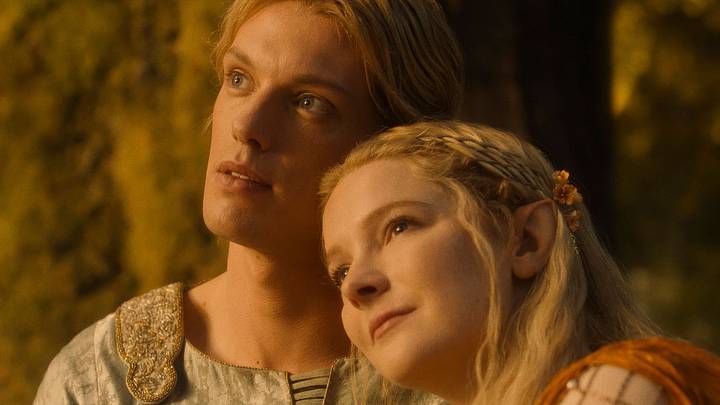
Prime Video’s The Lord of the Rings: The Rings of Power has spent three seasons bringing Middle-earth's Second Age to life, from the forging of the Rings to the slow rot of Númenor. The show has the rights to The Lord of the Rings and The Hobbit, but has secured one-off rights to other books, reflecting this material in its scenes. It has invented just as much material as it has adapted, if not more.
Perhaps Tolkien illustrator John Howe, who helped conceptualize sets for Peter Jackson’s LotR movies, put it best in the documentary series Looking for the Hobbit, saying: “Opening a book by Tolkien is like opening a hundred books, and you very quickly realize that you need to read those hundred lines that are in between.”
For viewers who want to know what Tolkien actually wrote about Sauron (Charlie Vickers), Galadriel (Morfydd Clark), and the Blue Wizards, these are the books worth prioritizing, roughly in the order to read them.
The Silmarillion
Dive in first with the legendarium book most relevant to the show. But if its archaic style turns you off, open The Lord of the Rings instead and come back to it when you've had that primer. Published posthumously in 1977 and edited by Christopher Tolkien, The Silmarillion is the closest thing the legendarium has to a Bible.
Its final sections are essential Rings of Power reading. The Akallabêth tells the full rise and fall of Númenor, which the show is now barreling toward. "Of the Rings of Power and the Third Age" covers Annatar, Lord of Gifts, Celebrimbor, and the Three.
Go back to the start, too. The Ainulindalë explains Eru Ilúvatar and the Secret Fire, which season 3 dared to give a voice. "Of the Maiar" introduces Sauron as one of the servants of Aulë the smith, which explains his craftsmanship. The chapters on the Noldor show the young Galadriel joining their rebellion against the Valar, and Celebrimbor's grandfather, Fëanor, at his most brilliant and most dangerous. And "Of Beren and Lúthien" shows Lúthien besting Sauron himself.

The Lord of the Rings
If you dare not start with the ambitious Silmarillion, then start where the show started. The Lord of the Rings, published in three parts between 1954 and 1955, contains the Second Age material that the show has indisputable rights to adapt directly.
The Fellowship of the Ring, The Two Towers, and The Return of the King are unmissable, but much of the Second Age stuff hides in the back. Appendix A covers the kings of Númenor and the line of Elros. Appendix B, "The Tale of Years," is the show's roadmap: Annatar's arrival around Second Age 1200, the forging of the One Ring around 1600, the sack of Eregion in 1697, and the downfall of Númenor in 3319.
The main text matters, too. In "The Shadow of the Past," Gandalf tells Frodo how the Elven-smiths made the Rings and how Sauron deceived them. At the Council of Elrond, Elrond remembers the Last Alliance and Isildur taking the Ring, the battle the show is building toward. And Galadriel tells Frodo she perceives the Dark Lord's mind while hers stays closed to him, the line the showrunners have said inspired her whole bond with Sauron.
And, perhaps it goes without saying, since so many people have seen the movies, but those curious about how Sauron's story ends should definitely pick this up.

The Hobbit
Where it all began. The Hobbit (1937) is set thousands of years after The Rings of Power, but it plants seeds the show keeps watering. Its offstage villain, the Necromancer of Mirkwood, is Sauron in hiding, a long way from the fair-faced Annatar but very much the same man. Gandalf and Elrond both appear, and Gandalf's fondness for Hobbits gives the Stranger's season 1 and 2 friendship with the Harfoots its payoff.
The Dwarves of Durin's line are here too. Thorin's company speaks of Durin's Day and of Thráin and Thrór, names the show has borrowed for its own Dwarven saga. Bilbo's company finds blades forged in Gondolin, a quiet reminder of the First Age history behind it all. And in Gollum's cave, Bilbo picks up a certain magic ring, the same one Sauron sweats over in season 3.
The Hobbit is short, warm, and the gentlest way into Tolkien.

Unfinished Tales
If The Silmarillion is the textbook, Unfinished Tales (1980) is the footnotes, and the footnotes are where the Second Age really lives. "The History of Galadriel and Celeborn" shows Galadriel distrusting Annatar in Eregion and Sauron having Celebrimbor tortured and killed, his body carried as a banner. "Aldarion and Erendis" is the only full story Tolkien wrote set in Númenor, and "A Description of the Island of Númenor" maps the kingdom the show has built.
"The Istari" is where the names Alatar and Pallando come from. For viewers who met the Dark Wizard (Ciarán Hinds) in season 3, this one is a must. Looking further ahead, "The Disaster of the Gladden Fields" tells how Isildur (Maxim Baldry) died and the One Ring was lost, an ending any future season of the show will have to reckon with.

The Fall of Númenor
Short on time? The Fall of Númenor (2022), edited by Brian Sibley and illustrated by Alan Lee, gathers Tolkien's scattered Second Age writing into one chronological volume. It follows "The Tale of Years" and fills each century with passages from across the legendarium, from the founding of Númenor to the War of the Last Alliance.
It's the most accessible single book on the age The Rings of Power adapts. It's also the best bridge between the show's storylines and the denser texts further down this list. Lee, whose concept art helped define Peter Jackson's Middle-earth, makes it as beautiful to look at as it is useful to read.

The Nature of Middle-earth
Edited by Carl F. Hostetter and published in 2021, The Nature of Middle-earth is a treasure chest of late Tolkien essays on how Middle-earth actually works. It covers how Elves age, where Glorfindel came from, and what Númenor's land and beasts looked like. Tolkien even considers the color of Gandalf's hat, which feels timely after season 3 handed Gandalf (Daniel Weyman) a hat of his own.
There are deep cuts for Rings of Power fans, too. Tolkien notes that Eastern Orcs laughed at Sauron's fair form, and he once imagined Wizard-like guardians sent to the Elves long before the Third Age. For a show that keeps expanding the roles of the Istari, it's essential context.

Morgoth's Ring
The 10th volume of The History of Middle-earth (1993) is not for beginners, but it explains more about the show's Sauron than almost anything else. "Laws and Customs among the Eldar" lays out Elvish marriage, which matters for Galadriel and Celeborn (Jamie Campbell Bower) in The Rings of Power. "Myths Transformed" digs into Morgoth's and Sauron's motives.
In one of its most striking chapters, Tolkien describes the "Morgoth-element" in matter, especially gold, and compares Morgoth pouring himself into Arda to Sauron pouring himself into the Rings. After season 3's forging scene, it will hit with a vengeance. The book also includes the "Athrabeth Finrod ah Andreth," a debate between Galadriel’s brother and a mortal woman about death. It's the same fear of mortality that will drive Númenor to ruin.

The Peoples of Middle-earth
The final volume of The History of Middle-earth (1996) is the deepest cut on this list, and the one that most closely touches the show's present. It includes information on Elros' family," tracing the kings of Númenor, and "Of Dwarves and Men," which explores Durin's folk and their languages. It also covers drafts of "The Tale of Years" and "The Shibboleth of Fëanor," containing an intriguing section on Galadriel.
Its "Last Writings" are a goldmine. In them, Tolkien gives the Blue Wizards new names, Morinehtar and Rómestámo, "Darkness-slayer" and "East-helper," and places their arrival in the Second Age, resisting Sauron in the East. It’s one of the Tolkien ideas most leaned on by The Rings of Power.

Beren and Lúthien
Edited by Christopher Tolkien and published in 2017, Beren and Lúthien traces Tolkien's most personal story through its many drafts. That includes passages from The Lay of Leithian, where Sauron appears as Thû, the necromancer of the Wizard's Isle, and is overthrown by Lúthien and Huan, the hound of Valinor. In Tolkien's earliest version, Sauron's role is played by Tevildo, Prince of Cats.
If season 3's ghost-summoning, shapeshifting Sauron felt new, this book proves it isn't. It's also the story of the line that runs from Lúthien to Elrond and Elros (Robert Aramayo), who finally met on screen this season.

The Letters of J.R.R. Tolkien
Tolkien's letters, first published in 1981 and expanded in 2023, are where the Professor explains himself. His long letter to publisher Milton Waldman, written around 1951, summarizes the whole legendarium, including the Second Age. It also contains his famous hope that his mythology would "leave scope for other minds and hands, wielding paint and music and drama."
Elsewhere, Tolkien muses that the Blue Wizards may have failed and founded secret cults in the East. Anyone wondering where the show found its Dark Wizard should start there. He also calls "Death and Immortality" the real theme of The Lord of the Rings, and admits he owed much of his earlier vision of Galadriel to Catholic imagination about Mary.
For anyone judging how faithful The Rings of Power is, there's no better place to finish.
The final two episodes of The Lord of the Rings: The Rings of Power season 3 arrive on Prime Video on November 25. For more on the season's lore, see whatJamie Campbell Bower teased about Celeborn's past and our guide to the new characters introduced in season 3.
 Add us as a preferred source on Google