

This article contains FULL SPOILERS for The Rings of Power season 3 episode 8, "The Doom of Men."
The season 3 finale of The Lord of the Rings: The Rings of Power has arrived on Prime Video, and I'm still trying to wrap my head around what exactly it is that I just watched. I said in my review for episode 7 that The Rings of Power is a consistently inconsistent show; at times it is genuinely fun and enjoyable to watch, at others, it leaves me scratching my head or groaning in disbelief. The early episodes of season 3 felt far more focused than previous seasons, often to their benefit.
But then, the other shoe dropped. Episode 307 had high highs and some disappointing lows, fumbling some critical moments for the series. By comparison, however, the season 3 finale, "The Doom of Men," makes it look like an unbridled masterpiece.
Say one thing for The Rings of Power, it can certainly be unpredicable. I never would have imagined that we'd be spending the majority of the episode's runtime with Gandalf, and putting off the seemingly inevitable battle between Númenor and the forces of Sauron as long as possible before veering hard left into a melodramatic anticlimax. Even knowing Sauron's surrender was coming from reading the books, the show's execution made it feel underwhelming.
"The Doom of Men" is like a fever dream. It went against basically every expectation I had for it, to such a degree that I largely watched it with a feeling like I was being Punk'd. Or in this case, let's say, Tom Bombadil'd.
Yeah, we've got things to discuss. Let's get into the spoilers for the episode.

The armies of Númenor and Mordor assemble
The episode begins with a dramatic sweep of the bay outside the Númenórean fortress of Umbar, where the fleet of Ar-Pharazôn (Trystan Gravelle) has arrived to make war against Sauron. He's accompanied by the Elven High King Gil-galad (Benjamin Walker) and Elrond (Robert Aramayo), who urges that the Númenóreans fall back to Lindon or Rivendell to link up with the Elven forces there. But Pharazôn is too proud to retreat; as he says, he has come "to slay a god." An amazing line reading from Gravelle that foreshadows the fragile power dynamics ahead.
Númenor presses on into Middle-earth without backup and against Elrond's counsel. Meanwhile, Sauron's vast army of Orcs, trolls, Men of Rhûn, and acolyes of the Dark Wizard Pallando (Ciarán Hinds) gather outside Barad-dûr. Sauron gives a victory speech; do we even need to say Charlie Vickers utterly crushed it at this point? He always does. He did again here.
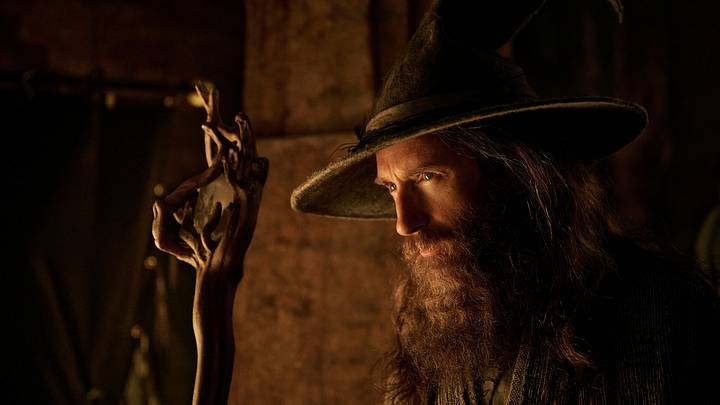
Sauron asks after a gift that Khamul the Easterling (Zubin Varla) has brought him. Cue, Gandalf (Daniel Weyman), looking worse for wear after the long trip from Rhûn. Last week, I griped about the lack of Gandalf this season; how I came to rue those words with this episode.

After the opening credits, we return to Pharazôn's camp, where Galadriel (Morfydd Clark) and Celeborn (Jamie Campbell Bower) have arrived to warn the Númenórean king of the size of Sauron's army. They share a last quiet moment alone on the hill overlooking the camp before joining the war effort, reflecting on what it feels like for Galadriel to have taken off her Ring while also dancing around the subject of their seemingly lost love. Clark and Bower's scenes remain a highlight.
Gil-Galad and Elrond see Galadriel as soon as she enters the camp, and she shares the news of both Arondir's (Ismael Cruz Córdova) death and the return of Celeborn. The show's penchant for leaning on Peter Jackson nostalgia rears its head with Gil-galad's forced "He fell" — a line Galadriel herself says in The Fellowship of the Ring — but thankfully we don't linger on it as the show shepherds us into the Elves' war council with Pharazôn.
The Númenóreans were prepared for a fight, but not against 100,000 Men of Rhûn and more than 50,000 Orcs. But Pharazôn has already walked into the trap; Sauron has cut off the routes of retreat or that Númenor could use to call for aid. Presumably Galadriel got this information from Theo (Tyroe Muhafidin) during their time in Barad-dûr last episode, since she and Celeborn presumably didn't have time to scout too far on their race to the camp.
Pharazôn plans to forge on, determined to give Sauron a battle fit for the poets. Gravelle continues to steal scenes, and he's being given great material to work with. Pharazôn is vindictive and arrogant, but there's a feeling that it's covering his fear. At the same time, he is being brave. He's never been a more fascinating character.

Sons of Elros and the Lord and Lady of Lórien
Later that night, it becomes clear just how terribly Sauron's forces outnumber the Númenóreans, when fell beasts swoop over their camp and the army assembles beyond. It provides a good excuse for everyone to do some soul searching, especially after Gil-galad urges Elrond and Galadriel to choose whether to stay for the battle or flee to safety. Neither of them turn their back, but it provides a runway for them to talk about Celeborn; meanwhile, Gil-galad speaks to Celeborn as well, right outside. It smells a little like a soap opera, but the writing remains sharp for Galadriel and Celeborn's dialogue, and they're so easy to root for that it's easy to go along with it, slow motion walk and all. They are not fully back to normal, whatever that even means for them, but there's a feeling they've taken the first step toward healing.
It comes at the perfect moment for them to go to Pharazôn's tent together, answering his summons for advice. This is the first time in the show that Celeborn and Galadriel are introduced as the Lord and Lady of Lórien, and unlike many of the show's attempts Jacksonian Easter eggs, this moment lands with a belated and outsize impact precisely because the show doesn't overemphasize it. It feels like the start of a new era for Galadriel and Celeborn, which the audience was privy to in the quiet moments just before this meeting.
Ahead of the season, showrunner Patrick McKay told us in an interview that Galadriel's overall story for the show is about her growing into the wise lady of the wood we meet in The Lord of the Rings. That transition is becoming much more apparent in the latter episodes of season 3, with her often serving as an advice-giver, and I'm very much here for it.
Pharazôn wants to understand Sauron more deeply, and out of everyone there, Galadriel and Celeborn have spent the most time around him. We don't see their answer, but the cracks in Pharazôn's armor make him even more interesting as a character here.
Outside, Elrond is having his own meaningful experience, when he spends time with the rank and file soldiers, meeting their fear of death with inspiring words about how his own brother, Númenor's founder, Elros, face death and believed it to be a unique Gift of Men, making each day burn brighter for the mortality of it all. He teaches them a Quenya saying which becomes their battle cry, and which they will later shout on the field as they face Sauron in a standout moment during the army stand-off.
Despite getting less screentime than many other storylines this season, I've really enjoyed Elrond's plotline exploring his connection to Núemnor. It often adds rich extra layers to any situation involving Elrond and the people of the island empire.

Istar of the Secret Fire
While a solid portion of the episode is dedicated to the goings-on in Pharazôn's camp as Númenor prepares for war, even more focus is being given to Gandalf, and the Dark Lord's efforts to tempt him into becoming one of his Ring-servants. Sauron offers Gandalf control of Middle-earth as one of his lieutenants; Gandalf resists, even when Sauron waves Rings under his nose.
From there, Gandalf suddenly ends up in a dungeon, where he comes face-to-face with a friend from his past: Nori Brandyfoot (Markella Kavenagh), the Harfoot who helped him find his way in the first two seasons. It was fun to see her back in the show again, even if it turned out to be an illusion of Sauron. Unlike Celeborn, Gandalf is able to figure out that he's speaking to Sauron when the Deceiver references Gandalf's hat, since Nori never saw him wear it. He then asks her a trick question about Nori's brother — she doesn't have one — exposing Sauron's lie. Kavenagh gets the chance to play evil, and she's shockingly scary for the few seconds before Gandalf is ejected from the vision.
Gandalf and Sauron contend in another vision after that, where Sauron challenges Gandalf to demand power from the Secret Fire to fight him, and Gandalf fires back with the mic drop that true servants do not demand. The philosophical debate lands and is engaging to watch, but it was around this point in the episode that I started wondering just how much time we were going to be spending with Gandalf in the season finale.
The answer, it turns out, was quite a lot. If there can be said to be one main character of this episode, it is him. Pallando convinces Sauron to spare Gandalf, so as not to waste such a powerful tool. This incites Khamul's suspicions, but Sauron dismisses him and offers Pallando a Ring of his very own. Sauron says that Pallando could be a "Witch-king no man can slay," the leader of his Nazgnagôl. This seemingly turns out to be a fakeout, however, since Pallando dies by the end of the episode. Is the show trying to throw us off the trail of the real Witch-king?
Pallando immediately goes to visit Gandalf, who retains his buoyant optimism that the Dark Wizard can be redeemed, beseeching his fellow Istar to flee the fortress with him. But Pallando is in too deep; he reveals to Gandalf that he accepted the Ring of Power from Sauron.

Of course, Gandalfis right about Pallando. Later that night, Gandalf tries to summon Tom Bombadil. While Old Tom doesn't show up quite yet, Pallando does return to take Gandalf upstairs...except Gandalf tricks him and manages to snatch the Ring from his finger. Sauron immediately sense that Pallando is no longer wearing it, but he's too far from the fortress to act.
Gandalf and Pallando then share a moment of recovery, with the Blue Wizard describing a glimpse he'd gotten of the pit of blackness and imprisoned wills inside of Sauron during his time wearing the Ring. We get another Tom Bombadil reference, and really, it should have clued us in about what was coming to have two in one episode. Gandalf's overriding mission becomes clear here: not to vanquish evil, but inspire good. This scene featuressome beautiful dialogue, as well as a montage that shows Galadriel reconciling with Celeborn, Pharazôn writing the challenging note he will deliver to Sauron on the morrow, and the real Nori Brandyfoot in a forest somewhere, gazing up at the moon.
Convinced to flee with Gandalf, Pallando leads him to Sauron's forge room to reclaim the Grey Wizard's staff. But Khamul is already there, arms himself with the staff, and starts a good ol' telekentic Wizard fight. Pallando comes to Gandalf's aid, and a three-way Wizard duel breaks out, proving that even Nazgnagôl suddenly become less interesting in battle once they pick up a Wizard staff. When the dust settles, Pallando is mortally wounded, Khamul is seemingly thrown to his death from the tower by the combined might of the Grey and Blue Wizard, and Gandalf is in possession of Pallando's Ring. More, all the acolytes whose wills were magically bound to Pallando are freed, and they desert the army of Rhûn.
The entire sequence with Pallando worked and was executed well, but I wish we had gotten a bit more time with him and Gandalf before the finale. It would have given his final moments much more weight.

Believe it or not, we're still not done with Gandalf's part in the story. As he leaves Barad-dûr, he runs into none other than Old Tom Bombadil himself (Rory Kinnear). I absolutely did not have Tom Bombadil returning on my bingo card for this season finale. It was a cheerful way to leave off Gandalf, with him once more traveling with Tom, who took the Ring from him and made it vanish into thin air. Presumably, that Ring will turn back up at some point in the show's future seasons, since Sauron ultimately ends up with nine Ringwraiths.
All told, the Gandalf storyline was extremely substantial and largely pretty entertaining and interesting. It's one big flaw is that it's in the finale at all. Gandalf has felt like such a side character this season, that to have him take up the bulk of the season finale, while a looming battle that has been set up all season receives far less attention, feels almost like a bait and switch. It was confusing to watch and try to imagine the priorities, that characters like Tom Bombadil should reappear when basically no action whatsoever happens with the armies the show has been foreshadowing all season long.
On some level though, the anticlimax is the point. Things seemed destined for certain doom at night, yet when the sun dawns and Gandalf has set off with Tom Bombadil, the winds have changed and life goes on. It's a beautiful idea, even if it doesn't necessarily make for great television drama.

The dawn brings change...and the doom of Men
The following day finds the playing field much changed. In addition to Pallando's acolytes, the Men of Rhûn have also desert Sauron, because they will not follow him without Khamul the Easterling, and Khamul is seemingly dead. I'm still banking on Khamul coming back as a Ringwraith, because he is one of he only canonically named Nazgûl from The Lord of the Rings, but for now his loss was enough to turn the tide of the battle.
Númenor, meanwhile, suffered not a single desertion. And they put their full might and fighting spirit on display before the Dark Lord, challenging him.
It's in this way that Gandalf won the battle: Not by leading armies, but by de-escalating, giving people a reason to leave instead of fight. It does feel very thematically appropriate to Middle-earth.
In spite of the fact that Sauron has just forged the One Ring, he does the unexpected, taking it off and surrendering to Pharazôn. This is no blessing for Númenor; if you couldn't immediately tell from Sauron's long stare at the Númenórean king, the Dark Lord looked at that guy and saw someone who could absolutely be corrupted. When Sauron tells Theo that he will give the humans the death they seek, he means it, and Gil-galad's proclamation that Sauron is the "Doom of Men" sends a shiver down the spine. What lies ahead for the DarkLord and Númenor should become one of the best storylines of season 4.
The stand-off is an epic scene that is drawn straight out of Tolkien's legendarium. I like that the show kept it in, and always expected that the season would end with Sauron's surrender. However, I still expected there to be some kind of battle, or even skirmish before we hit that point. Instead, The Rings of Power did a speed run, having the Dark Lord craft his ultimate weapon literally days before he takes it off again and surrenders, presumably leaving the One Ring with Theo or in hiding somewhere.
From an adaption perspective, I like many things about how this was handled. But in terms of fulfilling television, it left something to be desired. A lot of something. I'm all for subverting viewer expectations, but the fact that The Rings of Power spent all season building toward this clash between Númenor and Sauron, only to dial things in a completely different direction, was surprising in a bad way. I constantly wondered how the show's writers arrived at the decision to devote most of the finale to Gandalf while sidelining the main conflict, and how that idea stuck under scrutiny. When you bring back even Tom Bombadil for the season finale, it's easy to wonder whether the priorities about where to spend time make sense.

Verdict
"The Doom of Men" is a strange, unexpected episode of The Rings of Power, and a puzzling note on which to end the show's third season. Much of the build-up of the Númenor section was solid, with a good amount of anticipation for the looming battle as well as what comes after it. But the show's decisions about where to focus once more detract from things, spending a ton of time on a side plot at a crucial moment when the primary storyline really would have benefited from more time or action. It's a perfect recipe for underbaked payoffs on one side, and underwhelming anticlimaxes on the other.
Despite the fact that it remains faithful to a key turning point of the Second Age of Middle-earth, The Rings of Power season 3 finale does it in a way that makes it far less palatable than it might have been, turning a great twist into a boring, far less coherent choice.
Episode grade: C
All eight episodes of The Lord of the Rings: The Rings of Power season 3 are streaming now on Prime Video. The series has been renewed for a fourth season, which is expected to start filming in spring 2027.
 Add us as a preferred source on Google