

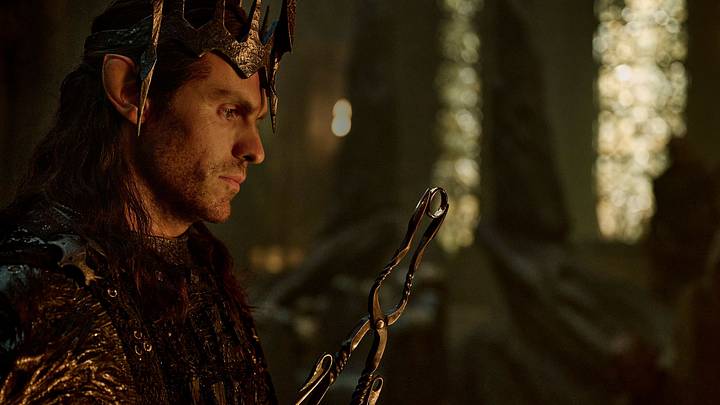
After three seasons and an epic journey across Middle-earth, we've arrived at the most critical juncture for Prime Video's Lord of the Rings prequel series: when Sauron creates the One Ring, gaining control of all the other Rings of Power and solidifying his reign of terror for centuries to come.
From the outset, The Rings of Power team has done everything possible to hype up expectations for the sequence where Sauron forges the Ring. It's featured very prominently in the marketing for season 3. Key creatives like actor Charlie Vickers and co-showrunner Patrick McKay have talked about filming it at length, with McKay in particular calling it “the single most ambitious, technically challenging sequence we’ve ever done on the show." Amazon even broke from their norm and set up one-night-only screenings of episode 7 in theaters around the world, so that fans could watch the Dark Lord do his jewelry-crafting on the big screen.
The writing has been on the wall: Sauron would forge the One Ring in season 3, and fans should expect it to be spectacular.
Now that we've seen it, I can say that the scene is spectacular, visually at least. There are some special effects during Sauron's fateful ordeal in the heart of Mount Doom that are breathtaking to watch, and I can genuinely say I've never seen anything quite like it. At the same time, the forging of the Ring itself sadly dropped the ball in a number of key ways. As for the episode as a whole, titled "Orodruin," it's even more egregious.
The Rings of Power has always been a consistently inconsistent show, with some parts soaring high while others plummeted to shocking lows in storytelling quality. Season 2's Númenor plotline felt to me like it fell apart on the editing room floor, with the cohesiveness just not working for its later aspects. By contrast, I could never have guessed that an episode heavily focused on the previously minor character of Eärien (Ema Horvath) would establish itself as one of the finest the show ever produced, but season 3 episode 2, "The Gift of Men," far exceeded all expectations and then some.
Now, we've arrived at another unpredictable juncture. The team behind The Rings of Power clearly knew that Sauron forging the One Ring was going to be one of the most important moments they ever committed to film, which would lay the foundation for so many of the stories to come in Middle-earth, including The Hobbit and The Lord of the Rings. And yet, "Orodruin" represents a borderline shocking drop in quality from what's come before. The writing is stilted. The storytelling is disjointed, delivering painfully underwhelming payoffs to several key plotlines that have spanned the season. The show opts for non-sensical or campy choices, at times even eschewing the less absurd (and undoubtedly cheaper) options that were right in front it.
In short, while "Orodruin" should have been one of the best episodes The Rings of Power ever produced, I'm haunted by the feeling that might be one of the worst of season 3, both for its own flaws and for how completely it fumbled its biggest and most critical moments.
As you can guess, we've got a lot to discuss. FULL SPOILERS for The Rings of Power season 3 episode 7 beyond this point.

Rejected by the mountain
"Orodruin" begins in just the way it should: with a scenic pan over Mount Doom, exploring the dramatic black volcano's peaks and rivers of molten lava. Whatever issues I may have had with this episode, it's visuals for this iconic Lord of the Rings location are not one of them. It's obvious the show put quite a bit of budget into realizing Mount Doom, and every penny was well spent.
We launch right into the central storyline of the episode, with Sauron (Charlie Vickers) arriving and having his Orcs cart a huge anvil into the heart of the volcano. Despite some chillingly well-delivered lines from Vickers in the Black Speech, the volcano sends Sauron fleeing, his Orc workers all melted to slag behind him. He flies his fell beast away from the mountain, and the camera pans down to his tower of Barad-dûr, where Galadriel is busy infiltrating his stronghold while he's out.
The idea of Sauron struggling to create the One Ring isn't something that is present in Tolkien's lore, but it makes total sense and fits with the arc the show has created for the character. I'm a huge fan of how this episode sets the stage before leaving us wondering how Sauron will pull it all off for the duration of its runtime.

Reunions and partings
While there is much and more to say about Sauron's storyline in "Orodruin," there are other characters in the episode as well. Before we devote ourselves fully to the Dark Lord, let's do the rounds and touch base with everyone else who features.
As Sauron flies away on his fell beast, Galadriel (Morfydd Clark) storms into Barad-dûr, slaying what few Orcs are on guard duty. I was glad that Theo (Tyroe Muhafidin) pointed out that there should be more Orcs defending the keep, because my initial reaction was that Galadriel's invasion of Sauron's most important stronghold felt far, far too easy.
As they reach the heart of the tower, Galadriel sees the corpse of the Elven smith Celebrimbor hanging on the wall. This was a moment that came as a surprise, since so much of Galadriel's journey to Mordor was built up as a rescue mission for Celeborn (Jamie Campbell Bower). I loved how the music changed as she took in his sad remains, accompanying some great silent acting from Clark.
After Theo warns Galadriel that Sauron's "plan is already underway" — thus, the lack of Orcs in Barad-dûr — she heads to the lower levels of the tower to break Celeborn out of prison. It's another nice touch that she uses her Ring to heal him. Celeborn is understandably suspicious of Galadriel. Even once he's sure it's her and not Sauron, he's still shaken by the fact that he was able to be deceived by the Dark Lord in the previous episode, wondering if it's proof that his and Galadriel's love is just a figment of their past.
Galadriel refuses to accept that submission, refuses to allow Sauron to be the thing that breaks them apart after they were just reunited. Bower remains an incredible addition to this show as Celeborn; he and Clark have stellar chemistry. I wish we had more time with them in this episode.
An important thing is revealed through their dialogue: Sauron's "plan" that Theo references isn't the forging of the One Ring. Galadriel tells Celeborn that the Elves and Númenóreans are walking into the Dark Lord's "snare," so clearly all those missing Orcs are somewhere other than Mordor or Mount Doom. That's a solid hook for the finale, raising the question of whether Galadriel can make it in time to warn Gil-Galad and the Númenóreans of the danger.
After their reunion, Galadriel and Celeborn head back upstairs, where she encourages Theo to drop his ring into a bucket of molten metal. He does so with great effort, seemingly freeing himself from it. They then part ways, with Galadriel and Celeborn racing back toward the Elves to warn them of what they've learned. In a truly baffling move, however, they just...leave Theo in Barad-dûr? Perhaps he wouldn't have been able to keep up with the Elves, but either way, it feels strange to not even be remotely addressed as they leave him in the middle of enemy-controlled territory. Doubly so because as soon as Galadriel leaves, Theo hears the whispering of his Ring, drains the metal, and surprise! It's still in tact, because as Sauron learned last week, it takes an incredibly hot fire to mold the gold and silver from Valinor contained in the Rings.
So sadly, it seems Theo is destined to slide back toward the dark. How exactly that will happen and what the repurcussions will be, The Rings of Power saves for its season 3 finale. This is just about all we get of Galadriel, Celeborn, and Theo this episode, and while I would gladly have taken more, it also feels pretty understandable considering how much other ground there is to cover.

Khazad-dûm bends the knee
After the opening credits, we get an arresting shot of Sauron's fell beast perched atop the Misty Mountains before we skip inside to catch up with the Dwarves. Sauron has come to Khazad-dûm, and at last, Thráin's (Eddie Marsan) allegiance to him can no longer be hidden. He bends the knee to Sauron in front of all his closest advisors and allies, pledging to get the seven Dwarven Rings for the Dark Lord by sunrise.
Charlie Vickers delivers yet another deliciously villainous line that reminds us why he's perfect for Sauron, telling Thráin that "Mordor's heart abounds with mercy," before naming the price of it: a trip down to the mithril mines. This rubs all the rest of the Dwarves the wrong, because it's forbidden by their god Aüle to allow anyone down there. Thráin delivers a speech to try and convince everyone capitulating is the smart choice, but these are Dwarves we're talking about. It should be no surprise that it doesn't take.
Narvi (Kevin Eldon) goes to retrieve Durin (Owain Arthur) and Disa's (Sophia Nomvete) children, intending to use them as a way to blackmail their parents into revealing the location of the Rings. But surprise, surprise, Narvi is secretly on Durin's side after all. He leads Gerda (Amber Mendez-Martin) and Gamli (Lee Braithwaite) to their parents. It's a subtle touch that Narvi is the one to pack up all the game pieces which hide the seven Rings, revealing that he's in on Durin's secret.
Another nice touch: Gerda cheats during the game with Gamli. Their lines to one another echo a later conversation a between Durin, Disa and Thráin. And as we see by the end of the episode, her cheating just might save the day.
Unfortunately, Durin's family doesn't even make it out of the apartment before they're aprehended by the bearded Dwarf lady who overheard them discussing the location of the Rings in episode 306. She brings them all to Thráin, and it isn't long before the king figures out that the Rings are hidden in a set of game pieces that has no business being in Durin's getaway bag.

This final confrontation with Thráin is a compelling scene, but mostly I'm just glad that there's any sort of real forward movement with the Dwarven storyline. It ends with Durin, Disa, and their children banished from Khazad-dûm. But considering that it's Durin's line that will one day carry on through to The Lord of the Rings, there's pretty much a 0% chance it will stick in future seasons.
While I felt a little torn about the banishment as a punishment (and the fact that Narvi just weirdly isn't included in it at all despite getting caught helping Durin and Disa), I do really like that it finally takes Durin's family and puts them out into Middle-earth proper. They have only appeared in Khazad-dûm or at its entrance for the entirety of the show so far. To see the family of Dwarves on the road feels like a genuinely fresh turn for the series, and I'm curious to see where it leads. They say they're headed to the Elves at Rivendell, but with Elrond in Númenor, there's no guessing what sort of reception Durin and Disa might find there.
There's one last surprise in store: the game piece that Gerda snuck off the board during her game with Gamli turns out to be one of those hiding a Ring, leaving Thráin with only six. While Sauron is sure to be displeased and I am very much looking forward to Thráin getting some comeuppance, I'm also really curious what is going to happen with this last Ring that's now traveling with Durin's family. We see that it tempts him, and that Disa helps give him the strength to leave well enough alone. Hopefully he can resist. We're fully off book with basically every part of the Khazad-dûm storyline this season, so one guess is as good as the next. I'm hoping the finale give us a hair more on the Dwarves before sending them off into the long wait between seasons.

Númenor under one banner again
Khazad-dûm isn't the only location wrapping up a succession crisis in this episode. Over on Númenor, Tar-Míriel (Cynthia Addai-Robinson) prepares for her marriage to Ar-Pharazôn (Trystan Gravelle), which will unite their factions and pull the island back from the brink of civil war. But there's one man who has a problem with it: Elendil (Lloyd Owen), the leader of Míriel's Faithful army and her sworn protector. He sneaks into the city to gain an audience with her before she can tie the knot with Pharazôn.
It's here that "Orodruin" starts to really show its cracks. Despite Owen and Addai-Robinson having great chemistry in season 2, The Rings of Power hasn't spent any time at all building up their relationship in season 3. As a result, this entire clandestine lover debate about whether they can escape together comes off stiff and unearned. The writing itself also struggles in weird ways here, as if it was phoned in compared to some of the rest of the episode. Elendil's afterhought proclamation that "the man is your cousin" made me laugh out loud, and it was only the first of several times that happened across this scene and the following montage, due to awkward deliveries and blocking.
It's an unfortunate call back to season 2, where Númenor floundered, that here at the point where it's tying off such a strong storyline it utterly drops the ball. On paper, this sequence should be an impactful one, with Míriel surrendering a large portion of her autonomy to save her people. The conversations with the Elves, at least, do drive that home, but Elendil's heroic ride to meet her and subsequent narration just do not meet the moment. It's a shame, considering how strong Númenor has been in other episodes this season. But hey, at least Elrond (Robert Aramayo) got to play officiant at the wedding.
We come back to Númenor one more time near the end of the episode, to see their fleet heading out to sea to go fight Sauron, with Faithful and King's Men united as one immensely powerful army. The set up for the season finale is just right; if only the road to get there in this episode could have been worthy of it.
However, it does leave us with one decent stinger: Elendil has a conversation with his sons, Isildur (Maxim Baldry) and Anárion (Andrew Richardson), who are somewhat split on how to navigate this next chapter for Númenor. Elendil silences them with a hard truth: "The queen has surrendered everything we hold dear to a man who holds nothing dear but himself, in a marriage that is an affront to the Valar. Númenor is already lost."
It is this family that will go on to found the Realms in Exile: Arnor and Gondor. The Rings of Power is wisely laying seeds for that turn here, and it's probably my favorite part of the Númenor storyline for this episode.

Reasoning in Rhûn
There's one final scene we have to discuss before we finally turn our attention fully back to the Dark Lord: a meeting between Gandalf (Daniel Weyman) and Pallando (Ciarán Hinds) in Rhûn. The enormous Rhûn army has nearly reached Mordor, but Wizards can always find time for a bit of a chat. Pallando seems wise to the fact that Gandalf is trying to steer him toward redemption; he counters by insisting Gandalf should ally with Sauron, so that eventually the two of them can find a way to check the Dark Lord's power.
In an episode with some serious writing highs and lows, this conversation is a reminder of what the show is like when it's on point. Gandalf and Pallando trade some great verbal barbs that are rolled up in philosophical musings, and it makes for a solid scene that sets up their imminent arrival in Mordor.
Despite good performances and writing here, however, I can't help but continue to feel that Gandalf has been sorely underutilized this season. He's appeared in three episodes out of the first seven (plus a blink-and-you'll-miss-it cameo in the season premiere), and for two of those episodes he's only had a single scene. It feels like The Rings of Power wasn't quite sure what to do with the Wizard, which is a shame considering that this should have been the season where his story finally took off, since he's accepted his new identity and has a focused goal of helping Pallando. Instead, it feels like it's tacked on to the show rather than an essential piece of it.
Even the army of Rhûn itself reflects the lower priority nature of this storyline. On Númenor, we see armies laid out in fields, adding to their visual splendor. So far every army shot in Rhûn, however, has been concealed by darkness, using it as a shield to get out of actually displaying the full force on screen. The first time it was fine, but at this point it's becoming a trend.

A conversation with a Balrog
Now at last, we turn our gaze back to Sauron, and his quest to create his ultimate weapon. We immediately find out that the reason he wanted to visit the mithril minds is just what we'd suspected: he wants a private chat with the Balrog, whom he knows is slumbering down there.
Sauron's confrontation with the Balrog is going to be a source of much discussion in the fandom. The Rings of Power made the daring choice to cast Simon Pegg (Shaun of the Dead) as the Balrog's voice, despite the fact that these creatures are never shown speaking in J.R.R. Tolkien's writings. However, on premise, I actually didn't mind the Balrog having lines. It served as a great way to fill in a ton of lore, hinting at the Balrog's standing in Morgoth's army during the First Age. It's always welcome whenever someone has a totally different perspective on Sauron, and we get there here, as the Balrog is one of the few beings to truly look down on the Dark Lord.
Sauron comes off as pathetic and wheedling during his meeting with the Balrog, proposing an alliance, then trying to insist that the Balrog owes him allegiance, then finally, just begging for a bit of advice. He wants to know how he can stand close to the evil-tinged fire of Mount Doom and not die — a valuable skill in a volcano. The Balrog's answer is poetic, but not exactly the most actionable advice. It's hard to see how it really helps Sauron, aside from serving as a brief little pep talk for his insecurities.
There's also the fact that Sauron promises the Balrog Khazad-dûm, and the Balrog proclaims that it knows about the Rings. How does it know? Has it ever even seen one? It surely hasn't talked to Sauron about them before, and since these are Second Age inventions, it wouldn't have seen them during the War of Wrath when it was active on the surface. It opens totally unnecessary plot holes.
In terms of visuals, the show does some interesting things with the creature, though. Its flashes to dimmer blue light were a fun touch. But ultimately, I felt that it was too much of a good thing, starting to bring down the illusion of this massive monster and pin it down more as a CGI creature with no real weight.

To Forge the One Ring
As expected, the visuals of the One Ring crafting are absolutely spectacular; it's easy to see why co-showruner Patrick McKay hyped this sequence so hard. It is terrible and beautiful to behold, especially when Sauron hammers his anvil, and ripples pass outward into the lake of molten fire before they're returned from the dark heart of the volcano.
There is no denying how impressive these final minutes of "Orodruin" are. Bear McCreary's score rises to the occasion as well, perfectly underlining this as a surrender to Sauron's most evil impulses in order to see his deepest, darkest ambition come to life. It should go without saying that Charlie Vickers also turns in a hell of a performance, arguably one of his best of the series. There are also plenty of standout moments, such as when Sauron casually tosses Fëanor's hammer — the priceless artifact which created both the Silmarils and the Rings of Power — into Mount Doom.
It's an incredible disappointment, then, that the writers behind The Rings of Power couldn't help themselves from going overly self-indulgent in this sequence in ways that completely drain it of some of its drama and borderline deific majesty. The Balrog narrates pretty much the entire sequence, totally distracting from what's on screen rather than adding to it. Some of that narration seems like it's meant to be the advice he gave to Sauron; if that's the case, it's vivid to listen to, but does not ring with anything exceptionally helpful. In general, the fact that after Sauron finally got the one thing he needed to create the Ring — gold and silver from Valinor, and the knowledge it was necessary — only to then need another thing — advice from a Balrog — just feels like the show making up excuses to shoe-horn the Balrog into the story here where it was totally unnecessary. Did Sauron really need the creature to tell him to give in to being evil, turn his back on Eru, and not back down when the fire was burning him?
The ending of the Balrog's narration is even more questionable, where it calls out several names of great evil followers of Morgoth from the First Age, urging them to witness Sauron's rise and that those who doubted the Dark Lord would hang their heads in shame — nevermind that the Balrog itself doubted Sauron five minutes prior to this speech, or that Ancalagon died in the First Age and Ungoliant probably did as well.
Next week, the moment that changes Middle-earth forever. pic.twitter.com/TFhmaZVSxI
— The Rings of Power (@TheRingsofPower) November 20, 2026
If it sounds like I'm nitpicking the Balrog speech a lot, it just goes to show how much it distracted me. I wanted to watch Sauron forge the Ring, and have moments of quiet mixed in where he processed the unfathomable magnitude of what he was achieving. Instead, the Balrog's presence is utterly intrusive, and feels primarily like it's there as a way for the writers of this series to wave a big flag that says "we've read The Silmarillion" in the most egregious way possible.
That's far from the only problem with the Ring forging, alas. Another truly questionable moment comes near the end, where Sauron holds the Ring, presumably pushing his evil will into it, and then collapses, seemingly dead. But before he collapsed, he had the presence of mind to put the Ring back on its anvil...where it zips off onto the ground, then scoots onto his hand like it's Thing from The Addams Family. As far as introductions go to the most evil and deadly weapon on Middle-earth, it's about as goofy a path as the show could have chosen.
In Peter Jackson's films, the Ring's will leading it to those who would help it further its own aims was always done in a way where the Ring, despite having motives of its own, still moved like a regular piece of jewelry. It falls toward people's hands, slips onto them, slips off at key moments, etc. Seeing it scoot around on the rocks here is totally immersion breaking, especially when the much simpler and cleaner choice of having it just fall onto Sauron's finger instead of next to it was right there; or even to have him just hold it as he collapsed, rather than plop it back onto the anvil before he keels over. It's an almost egregious use of special effects budget that only made the scene worse, instead of better.

Ultimately, it's hard to call Sauron forging the One Ring a total failure of a scene. There is plenty about it that is incredible, and sets it apart as a singular sequence in the show. But it's also not quite the home run it should have been, especially after how much it has been hyped leading up to this moment. The fact that The Rings of Power managed to fumble this critical juncture not through lack of resources, but questionable judgment about what would make the scene better or not, is absolutely baffling. When you add it in with the other stumbles, like Númenor, it turns what should have been one of the season's best episodes into arguably one of its worst.
The closing montage of the episode shows the Elves react to Sauron wearing the One Ring for the first time. High King Gil-galad (Benjamin Walker) stands on a boat with the Númenórean fleet, which screams green screen in a way that, once again, took me totally out of the moment. Círdan the Shipwright (Ben Daniels) feels Sauron's voice in his mind from the Elven warcamp on the mainland. And Galadriel also hears him as she and Celeborn ride away from Mordor. All three take off their Rings with obvious reluctance, and after the chaos that was Sauron's Ring-forging, it's refreshing that the show did manage to preserve this canon reaction from the Elves. A glimmer of light at the end of a confusing, weird, sometimes breathtaking and often disappointing episode.

Verdict
"Orodruin" is an absolutely confounding episode of The Lord of the Rings: The Rings of Power. While it does some things right, it feels in many ways like it does far more wrong, from the rushed and awkward ending to its long-running Númenor civil war storyline, to the totally unnecessary addition of the Balrog, to Sauron — Sauron — having a death fakeout. The forging of the One Ring should have been one of the most unquestionably excellent moments of the entire show, and it's sad to see The Rings of Power's writers trip over themselves at the eleventh hour, making self-indulgent decisions that drew focus away from the main event. It's not quite a total miss, but it's a huge fumble of what should have been a triumphant moment for The Rings of Power.
Episode grade C+
 Add us as a preferred source on Google